The Young Academy of Europe AGM 2023 and Academia Europaea’s Building Bridges in Munich

Building Bridges 2023, the 34th Annual Conference of Academia Europaea (AE) and the 12th Annual General Assembly (AGM) of the Young Academy of Europe (YAE) was organised on 9-11 October, 2023, at Ludwigs-Maximilians-Universität (LMU) in Munich, Germany. At the YAE AGM on​ Monday 9 October, Katalin Solymosi (co-Vice-Chair) welcomed the participants and presented the activities of the YAE in 2022-2023. These included, among others, the Arts & Science webinar series, one 10th Anniversary webinar with previous YAE chairs as speakers reflecting on YAE, the ERC Starting Grant Mentoring Event about narrative CVs, YAE’s collaboration with other stakeholders and participation in European level science policy and science advice initiatives, as well as our publications and interviews. Scott Bremer (co-Vice-Chair) and Katalin Solymosi then handed over the membership certificates to the new members present at the AGM, and Linn Leppert (Treasurer) presented the financial report of the last year.

This was followed by a panel moderated and organised by Serim Ilday (Activities Chair) with insightful research talks by new YAE members from the three different domains. Núria Codina talked about literature in the context of migration, Philippa Warren about restoration of breathing after spinal cord injury, and Bruno Ehrler about high efficiency solar cells. The elections of the new Board were held in hybrid format: Katalin Solymosi was elected as new Chair; Scott Bremer was re-elected as Vice-Chair; Jihan ZakarriyaMarc Yeste and Philippa Warren were elected as new members of the Board. At the AGM, Gemma Modinos and Sylvestre Bonnet were elected to the Advisory Council of YAE, where they will start their 5-year-term in January 2024.

Participants of the Annual General Assembly of the YAE in Munich, October 9, 2023

In the afternoon Susie Edwards from WonderIf held an inspiring leadership workshop which allowed participants to exchange and reflect about their experiences and best practices of group leadership, and to realise the great expertise and knowledge that is already present within the YAE community and only needs to be shared in order to help each other’s personal development. This was followed by an Arts & Science panel discussion in which members shared their videos, drawings, microscopic images, music and other artistic activities related to their research. Members had the possibility to continue networking and discussing during the coffee and lunch breaks, as well as the nice dinner at Hofbräuhaus München. We are grateful to LMU and the AE Munich Hub for helping us to organise our AGM at LMU.

Excellent science was in the focus of the ​​​​​Building Bridges 2023 Conference on 10-11th October, featuring brilliant research talks from each Class of AE with speakers from both AE and the YAE. On the 10th October, the passionate talk by Mona Simion about fact-checking and disinformation elicited a great response from the audience, as well as the interesting presentation of Marc Yeste which discussed how semen contributed to fertilisation and early embryo development. On the 11th OctoberMáté Csanád started the day by an insightful talk about femtoscopy and particle accelerators deciphering the Big Bang, and Scott Bremer’s inspiring presentation about seasonal cultures in New Zealand shaping adaptation closed the conference. In addition to these research talks, along with Steve Evans, Poul Holm and Peter Wagner (AE members), Katalin Solymosi took part in a panel discussion entitled “Healthy Food and Sustainable Agriculture: Exploring Transformative Practices” which presented the work of the Task Force for Environment, Sustainability and Climate of AE.

Katalin Solymosi and Scott Bremer are handing over of the André Mischke YAE Prize for Science and Policy to Renaud Jolivet

On this day, Katalin Solymosi and Scott Bremer awarded Professor Renaud Jolivet with the André Mischke YAE Prize for Science and Policy. In additon to his scientific excellence recognised as a full Professor at the Maastricht Centre for Systems Biology, and Chair of Neural Engineering & Computation at Maastricht University, he has been involved in science policy at the European level by taking up various roles in the Marie Curie Alumni Association (MCAA), the Initiative for Science in Europe (ISE) and the European Commission’s European Research Area Forum. In addition to his latest research deciphering the imaging and modelling of the plasticity of neuronal networks within the brain, Renaud Jolivet also shared his experiences and vision for science policy at the European level in his talk entitled “Spanning boundaries between science and policy”. The video recordings of the BB2023 event are available here.

Panel discussion on the ethics of science communication

25 September 2023, 14.00-15.00 CEST, Zoom

The third seminar in a programme culminating in the AGM, titled: ‘Arts and Science: Mutual Creativity and Inspiration’.

In the third Arts & Science event of the Young Academy of Europe, we will host a panel discussion between three scholars with different perspectives on art as a means of science communication, with a focus on the important ethical considerations in doing this work. With rapidly growing interest from scholars in working with the creative arts, toward novel channels of communicating science to new audiences, it is important to be mindful of the pitfalls of this work and to craft these collaborations with care.

Peter Weingart is a Professor Emeritus of Sociology, Sociology of Science and Science Policy at the University of Bielefeld, interested in science advice to politics, science–media interrelation, and science communication.

Miriam Sturdee is a lecturer at the University of St Andrews in the School of Computer Science, focusing on the intersection between computing and the arts, and is especially interested in how arts-based approaches can inform technical fields within STEM.

Joseph Lindley is a Senior Research Fellow at ImaginationLancaster. He aims to capture and communicate the value of Design Research, showing its relevance to help address the 21st century’s socio-technological challenges.

Sign up to this event by clicking on the button below and we will send you a Zoom link on the day of the panel.

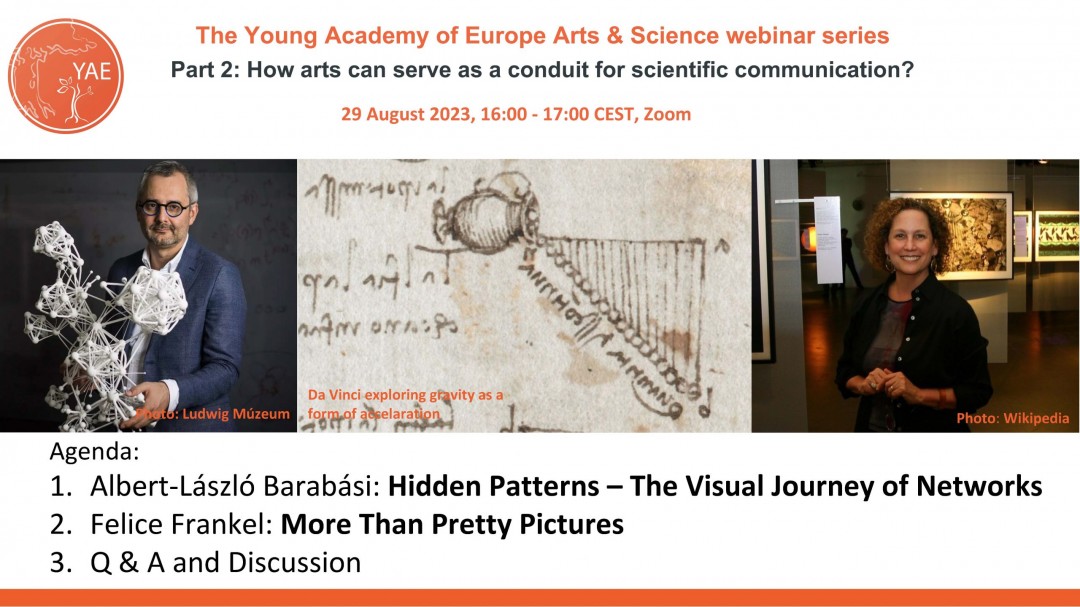
How arts can serve as a conduit for scientific communication

29 August 2023: 16.00 – 17.00 CEST. On Zoom

In the second Arts & Science event of the Young Academy of Europe, we will explore how arts can serve as a conduit for scientific communication. Complex scientific concepts can be made more accessible and engaging through artistic representations. Visualisations, animations, and interactive exhibits bridge the gap between the abstract and the tangible, enabling the public to grasp intricate scientific phenomena and foster a sense of wonder and curiosity.

We have the pleasure to announce you our two speakers, Prof. Albert-László Barabási, network scientist (Northeastern University, Harvard University, Central European University https://barabasi.com, https://scholar.google.com/citations?user=vsj2slIAAAAJ&hl=en) and Felice Frankel, science photographer and researcher (Massachusetts Institute of Technology, https://felicefrankel.com/). 

In addition to his widely recognized scientific work and bestselling books aimed at a broader audience, Albert-László Barabási is a pioneer in the visualization of network science and had several artistic exhibitions showing the beauty of network science data in prestigious art galleries. Besides being a scientist, Felice Frankel is also an award-winning photographer developing workshops, courses and conferences, and writing books with the aim to explore new approaches to promote the public understanding of science through visual expression. Please find below the title and a short summary of their 20-20 min talks, after which we’ll have discussion around the topics raised by our speakers and the audience.

Register via Eventbrite by clicking on the button below, and you will be sent the Zoom link closer to the time:

Hidden Patterns: The Visual Journey of Networks

Albert-László Barabási

Network Science Institute, Northeastern University
Division of Network Medicine, Harvard University,
Department of Network and Data Science, Central European University

The essence of complexity lies in connectivity. Whether we examine the vast expanse of the World Wide Web, the intricacies of a cell, or the marvel of the human brain, their complexity invariably stems from intricate interconnected networks. Connectivity is foundational to our biological makeup, our social  Felicfabric, and our communicative prowess. In this talk, I will chart the 25-year odyssey of BarabásiLab in crafting the visual lexicon of networks and connectivity. It will be a journey from the “interactome”—the subcellular networks that underscore our health—to the “connectome”—the neural network that delineates our consciousness. I will chart the transition from the nebulous ‘hairballs’ to the clear connections of 3D printed physical networks, from datavis to the dataism, and from research papers to art museums.

More Than Pretty Pictures

Felice Frankel

Massachusetts Institute of Technology

Graphics, images and figures — visual representations of scientific data and concepts — are critical components of science and engineering research. They communicate in ways that words cannot. They can clarify or strengthen an argument and spur interest into the research process. The process of making a visual representation requires you to clarify your thinking and improve your ability to communicate with others. In this talk, I will show my own approach to creating depictions in science and engineering—the successes and failures. Included will be a discussion about how far can we go when “enhancing” science images.

Seminar on how science inspires art and art inspires science

29 June 2023: 15.00 – 16.00 CEST. On Zoom

(Image: Fabian Hefner. Image via theverge.com)

This year the YAE is organising a programme of seminars culminating in the AGM, titled: ‘Arts and Science: Mutual Creativity and Inspiration’. This  is the first seminar of this programme.

At first sight the sciences and the arts may seem worlds apart.

The arts encompassing various disciplines, from visual arts to literature, music, theatre, and dance, offer us a window into the human experience.  Artists harness creativity to convey ideas, evoke emotions, provoke thought, challenge societal norms, and inspire change.

The sciences are largely a pursuit driven by curiosity for unraveling the mysteries of the natural and social world, relying on systematic observation, experimentation, and rigorous analysis to advance understanding, fuel technology, and support informed decisions about our world.

With this event we highlight that the arts and sciences are interconnected spheres of human exploration and expression. They complement and inspire each other, which opens doors to new perspectives, uncharted territories, and endless possibilities for human creativity and intellectual growth.

This one hour virtual seminar on Zoom starts with two talks from artist-scholars working across the arts and sciences, and blurring the distinction, followed by discussion between the speakers and the audience, where attendees are encouraged to share their own experiences. Sign up here:

Anastomosal Science

Marjolein Pijnappels – Wondermash, The Netherlands

Science doesn’t take place in isolation. It is a never-ending process of truth-finding, of saying something substantial about the world around us, and is influenced by that very world, and by us. Marjolein Pijnappels, MSc will talk about her co-emerging practice as a futures ecologist who entangles science with art and myth.

The Anteater’s Culinary Guide

Ofer Feinerman – Weizmann Institute of Science, Israel

One of the most spectacular of any of this world’s animals is closer than you think, in fact, right below your feet. Ants are not only fascinating but also highly approachable. Our comic book tells the tale of a young girl and her visitor – the hungry anteater.  These two draw the reader from her familiar neighborhood environment into the tiny world of the ants. As the characters become curious about the ants we encourage the reader to go out and experience the same through their own eyes. The graphic novel is interspersed with tens of ideas for open-ended experiments. These are aimed at introducing the reader to the local  species and their behavior and more generally, to the scientific process and independent thought.

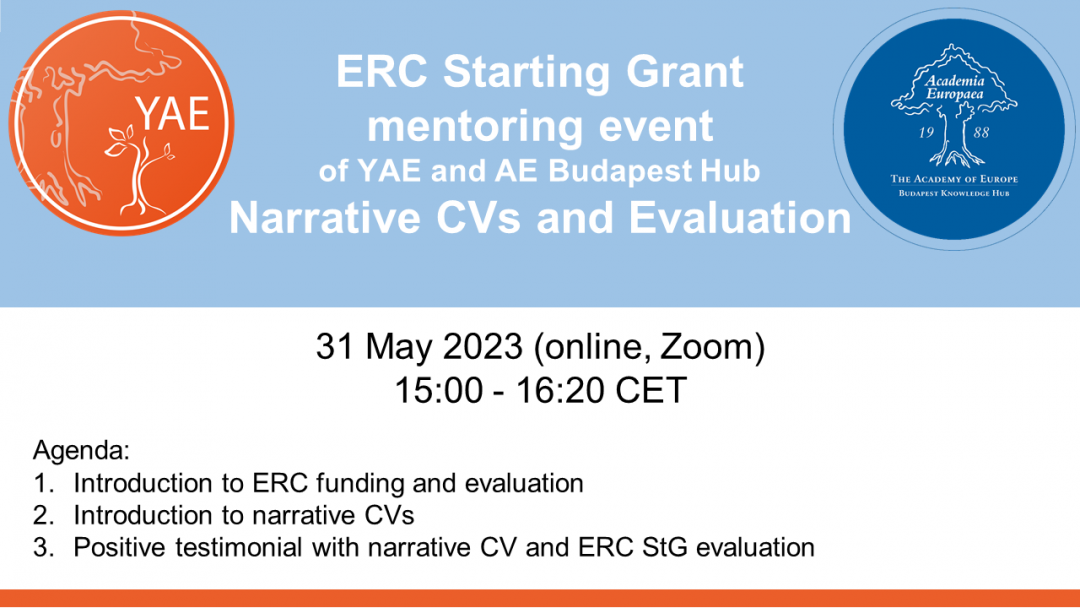
ERC Starting Grant Mentoring Event – Narrative CVs and Evaluation

Date: 31 May 15.00-16:20 CET
Platform: Virtual – Zoom

The Young Academy of Europe (YAE), in collaboration with Academia Europea (AE) Budapest Knowledge Hub, continues the event series focusing on increasing the number of European Research Council’s (ERC) Starting Grant (StG) applications from EU13 and associated countries. 

The first two events, held in September 2020 and November 2021, focused on the overall introduction of the grant scheme and evaluation procedures. The third event will be held on the 31st of May 2023, focusing on the narrative CV format and its potential effects on the evaluation procedures.”

The event will start with a presentation by Robbert Hoogstraat about evidence-based CVs as implemented by the Dutch Research Council (NWO). Next, Sean Sapcariu from the Luxembourg National Research Fund will introduce narrative CVs and describe their goals and potential effectiveness in the ERC StG applications. Last, the testimonial from YAE activities chair Serim Ilday on how she utilised a narrative CV in her successful ERC StG application will follow. The event will end with a Q&A session where attendees are encouraged to ask questions to the speakers and László Lovász, the academic director of the AE Budapest Knowledge Hub and member of the ERC Scientific Council

You can find more information about the program and registration on our website. If you are interested in attending, please register on Eventbrite by clicking here:

Programme

15:00-15:05 Opening – Moniek Tromp (YAE Chair)

15:05-15:25 Narrative CV assessment – Robbert Hoogstraat (Dutch Research Council)

15:25-15:40 Insights into narrative CVs – Sean Sapcariu (Luxembourg National Research Fund)

15:40-15:50 Positive experience with narrative CV for ERC StG application – Serim Ilday (Bilkent University, Turkey & Bochum University, Germany)

15:55-16:15 Q & A

16:15-16:20 Closing remarks – László Lovász (AE Budapest Knowledge Hub President, ERC Scientific Council)

Moderator: Katalin Solymosi (YAE vice-chair, AE Budapest Knowledge Hub co-chair of the Danube Region Thematic Mission)

Information on the previous events and their video recordings is available below and on the YAE website. 

The 1st YAE ERC-StG event: 

In 2020, YAE organised a well-attended virtual ERC-StG mentoring event focused on providing guidance and support to applicants from under-represented countries. The event included an interactive session, where the attendees were divided into domain-specific break-out rooms (for SH, PE, LS) for specific grant-writing tips from ERC grantees.The recordings from these sessions are available on our website.

The 2nd YAE ERC-StG event:

In 2021, YAE and AE Budapest Knowledge Hub hosted the second event with a focus on describing how evaluation panels work and what they look for in shortlisting a proposal. Similar to the first event, domain-specific break-out rooms (for SH, PE, LS) were utilised. In addition, a plenary presentation was held discussing typical roadblocks and weaknesses of the applications from EU15 countries based on ERC evaluation reports.A document containing general advice for ERC grant writing provided by an anonymous reviewer is also published on our homepage.

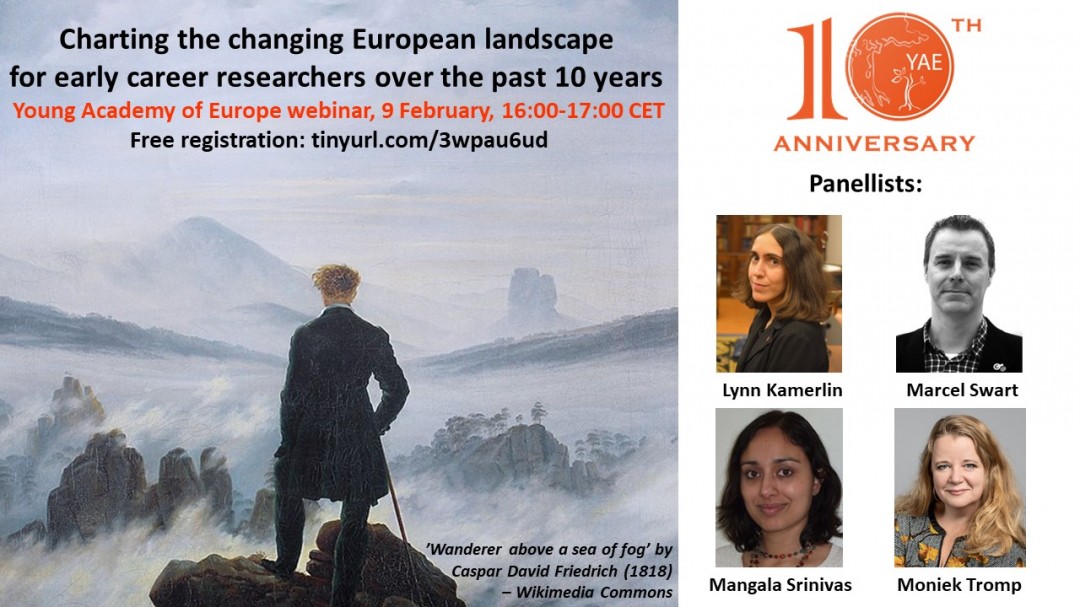
Panel discussion: Charting the changing European landscape for early career researchers over the past 10 years

Zoom Event: Thursday 9 February 16.00 – 17.00 (CEST)

The working conditions and incentives for Europe’s early stage faculty have significantly changed in the past decade. Scientific policies, norms and cultures have been shifting, at times dramatically, and an increasingly active network of Academies and advocates have been outspoken in helping younger scholars navigate these changes; the Young Academy of Europe (YAE) among these.

In this moment, as the YAE celebrates its 10th Anniversary, it is opportune to reflect on what has changed for early stage faculty in Europe – for better or worse – and chart the most important changes we should pursue for science governance in the next 10 years.

With this motivation the YAE is organising a one-hour, Zoom-based panel discussion between some of the past and present Chairs of the YAE, centred around three broad questions:

  1. What are the most significant changes to the European research landscape for early stage faculty over the past 10 years?
  2. What have been YAE’s most significant impacts on this landscape over this period?
  3. What are the most critical changes YAE and others need to effect to this landscape over the next five years?

The panel will be comprised of four scholars: Lynn Kamerlin, Marcel Swart, Mangala Srinivas and Moniek Tromp – each of whom will provide perspectives from different time periods, and disciplines.

This event is open to YAE members, and any other interested individuals. The event will be interesting for anyone who wants to see current early career researchers and early stage faculty relative to a 20-year trajectory of research in Europe, and the future of research policy. There will be opportunities for the audience to ask questions of the panel.

YAE member consultation on the research assessment reform

We would like to invite you to a closed meeting among YAE members as a consultation on your views about the current initiative to reforming the way research and researchers are evaluated in Europe. The meeting will be held online on Tuesday 4th October at 4pm CET – this will be an informal discussion among YAE members as the YAE Board would like to hear your views on this process. In particular, we are seeking a diversity of views in terms of the disciplines and geography that encompasses our membership.

To provide some background, the YAE has played an active role in a recent initiative between research stakeholders across Europe and the European Commission that culminated in the recent publication of a list of core commitments towards the research assessment reform. The agreement was put together after months of consultations among a coalition of a core group of 20 organisations (including the YAE), and more than 350 interested stakeholder organisations from across Europe. 

Briefly, these core commitments describe a new way to evaluate research outputs that recognises the diversity of research careers and contributions to science; bases research assessment primarily on qualitative evaluation by peers; abandons the “inappropriate uses” of journal and publication metrics; and avoids the use of international rankings of research organisations in research assessment. The agreement can be found here.

Please join us in this consultation so that we can have a better understanding of the position of the YAE membership on this matter. The session will be organised by Scott Bremer (YAE Activities Chair), moderated by Gemma Modinos (YAE Chair), and will have brief introductions to the topic and the YAE work on it by Moniek Tromp (YAE Vice-Chair), Katalin Solymosi (YAE Recruitment Vice-Chair), and Toma Susi (YAE member and former YAE Vice-Chair). You can also find more information on this initiative through the recent talk that Toma gave with the Commission for the European Research Area (ERA) here (video duration 11 mins).

Please register using this link:

Please note that the event is restricted to current YAE members only.

Login details will be circulated to registered attendees closer to the event. If you have any questions about the event please contact Scott (activities@yacadeuro.org) or Gemma (chair@yacadeuro.org). 

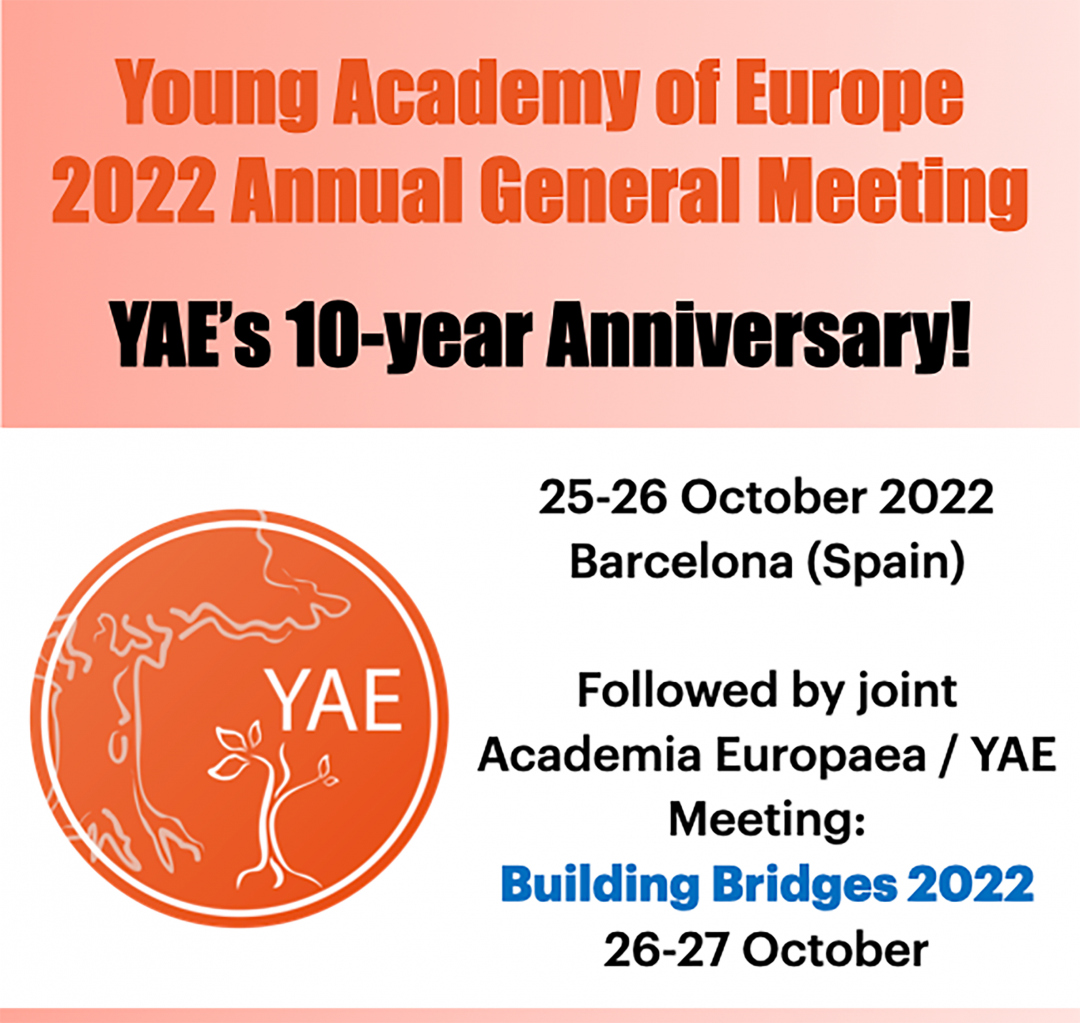
2022 Young Academy of Europe Annual Meeting

We are excited to announce that the 2022 YAE AGM will be an in-person meeting, held at the Universitat Pompeu Fabra Barcelona – Campus del Mar (Spain) in October. This year also marks the 10th anniversary of the YAE, and we are very much looking forward to celebrating this milestone together with you in Barcelona! 

The 2022 YAE annual meeting runs across Tuesday 25th October from 14:00 to 17:30 (room 226), and Wednesday 26th October from 09:30 to 12:00 (room 206). It will be held at the Universitat Pompeu Fabra, Mar Campus – see Building 61 in this map: https://www.upf.edu/en/web/campus/campus-mar. We will be in room 226 on Tuesday 25th and in room 206 on Wednesday 26th. We have put together an outstanding programme that includes renowned invited guests, research talks by recently admitted members, and opportunities for brainstorming and exchange. This includes a dedicated Science Communication Lab with expert guest speakers Profs. David Budtz-Pedersen and Rolf Hvidtfeldt. Please see the full programme below.

Registration to the full YAE AGM event is €130 – this includes access to all the AGM sessions on the 25th and 26th October, plus the YAE 10thanniversary dinner on Tuesday 25th. Please register using the link below (orange). This year you will register and pay for the AGM using the Eventbrite platform. After purchasing your ‘ticket’, Eventbrite will provide you with confirmation of your order. We understand that this order confirmation may not provide sufficient information for some of your institutions. If this is the case, please email Activity Chair Scott Bremer (Scott.bremer@uib.no) to request a more detailed invoice. When you contact Scott, provide your institution’s full name and address, and VAT number.

While registration is separate, the joint Academia Europaea / YAE meeting – Building Bridges 2022 – will go ahead immediately after our AGM in next door at the fabulous Parc de Recerca Biomedica de Barcelona. The programme includes excellent sessions including the Balzan lectures, the AE Gold Medal lecture, and two YAE-led sessions: a debate titled “Towards an inclusive and representative academic landscape” on Wednesday 26th, and the 2022 André Mischke YAE Prize lecture by this year’s awardee Dr. Gergely Toldi on Thursday 27st. We wholeheartedly encourage you to not miss these sessions! You can register for Building Bridges 2022 following the link below (blue).

Please note that the exact room where the YAE AGM will be convened is being finalised, and as soon as this information is available it will be updated on the website and emailed around to registered participants. This will include detailed instructions on how to get there. In planning your trip you may want to consult the Academia Europaea’s Building Bridges website for accommodation options: http://www.buildingbridges-acadeuro.org/accommodation/

Schedule

YAE at ESOF 2022

We are delighted to announce that the YAE will be widely represented at this year’s EuroScience Open Forum (ESOF) conference. The biennial ESOF conference is the largest interdisciplinary meeting on science and innovation in Europe, for and with society.

Gemma Modinos, YAE Chair, will give an invited keynote address on Friday 15 July at 15:00-16:00 (CEST) on the Main stage (Stadsgehoorzaal) in Leiden (also online), titled “Sustainable Academic Careers: Young Scholars’ Perspective”.

Furthermore, the YAE has two accepted sessions in this year’s programme.

Out of 300 submitted proposals for ESOF2022, the a sesssion on Research Precarity initiated by the Science Outreach Task Force of YAE and led by Noel de Miranda and Katalin Solymosi was accepted. The session will be organized jointly with the Young Academy Leiden and the International Consortium of Research Staff Associations (ICRSA). The session is entitled “New radical career paths for researchers – breaking the existing norm of short-term contracts leading to precarity and will take place on Saturday, 16th July, from 9:45 am – 11:00 am in Kamerlingh Onnes Building (KOG) in Leiden (but also online). The YAE will be represented by Anna Kuppuswamy (selection committee vice-chair of the YAE). The panel aims to initiate and continue discussions on how to reinvent academic careers such that we can support a healthy and sustainable academic system.

Furthermore, along with Academia Europaea Cardiff Hub and CALIPER, the YAE is also involved in another ESOF2022 panel entitled “The Chair: Fact or Fiction? Addressing the challenges faced by women leaders in academia” which will take place on Saturday, 16th July at 14:15-15:30 CEST online. Moniek Tromp (vice-chair of YAE) is one of the panellists, with Gemma Modinos (chair of YAE) chairing the session. The proposal was developed by Mangala Srinivas (previous chair of YAE, CALIPER), Katalin Solymosi (YAE), Juliet Davies and Louise Edwards (AE Cardiff Hub) and will feature discussion on how to create a brighter future for women aspiring to fulfilling academic careers and leadership positions, as well as an effective work-life balance. A keynote will be delivered by Susanne Täuber for the University of Groningen. You can find more information on this session on the AE Cardiff Knowledge Hub website following this link.

ESOF is an excellent conference and we look forward to having a large YAE representation. We therefore strongly encourage you to register to attend. More details on the event, programme and registrations can be found on the ESOF website: https://www.esof.eu/

The Diamond Open Access Model: what impact on research?

On the 28th of March 2022, the Academia Europaea Cardiff Knowledge Hub, KU Leuven Libraries and the Young Academy of Europe co-organised a webinar on the Diamond Open Access publishing model, where scientific articles are not subject to Article Processing Charges (APCs).

During the webinar, the panellists discussed the latest developments in Open Access publishing and what it means for researchers, research-intensive institutions, funding bodies, libraries and publishers.

Diamond journals represent a large percentage of open access publishing output and are mostly owned and managed by universities, learned societies and other not-for-profit organisations. Two organisations leading the development of an international strategy on Open Access, Science Europe and Coalition S, have recently launched an initiative that will offer worldwide support to building and sustaining the Diamond Model. The action plan was published on 2nd March.

The webinar was chaired by Professor Ole Petersen, Honorary Vice-President, Academia Europaea. The panellists involved:

  • Professor Johan Rooryck, Executive Director of Coalition S
  • Dr Bregt Saenen, Senior Policy Officer at Science Europe
  • Professor Sarah de Rijcke, Scientific Director at the CSTS at Leiden University
  • Professor Demmy Verbeke, Head of KU Leuven Libraries Artes
  • Professor Toma Susi, FYAE and former YAE Vice-Chair, and Member of the Scientific Advisory Board at Open Research Europe

The summary of the webinar, the panellists’ slides, and the briefing paper can all be found on the AE Cardiff Knowledge Hub website here.