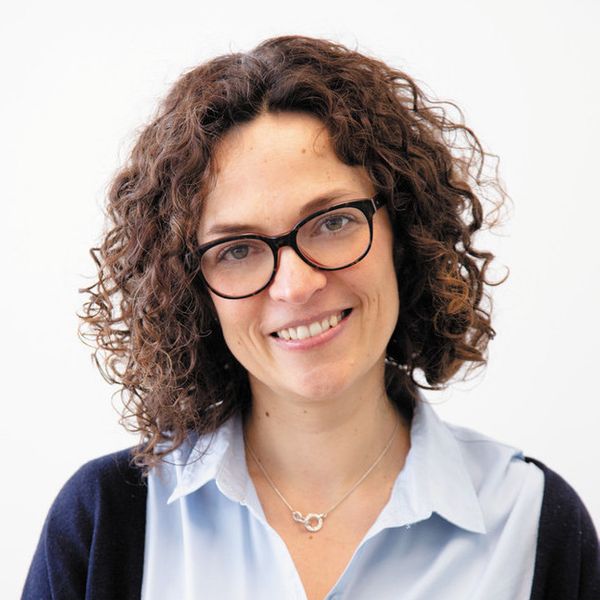
Prof. Verhelst is working in microelectronics and chip design, pioneer in custom AI processors, and is head of a research team at the MICAS laboratories (MICro-electronics And Sensors) of the Electrical Engineering Department of KU Leuven, Belgium. For her successes in research, she received numerous awards, prizes, fellowships, and grants including the Laureate of the National Academy of Science and Arts in Belgium, ERC Starting Grant, Fellow of the European Laboratory for Learning and Intelligent Systems (ELLIS), an IEEE distinguished lectureship, and grants from industry (e.g. Intel, Qualcomm, Huawei, Nokia). Verhelst has been involved in various organizations and activities, e.g. for the enhancement of science literacy and a larger uptake of STEM studies as member of the Flemish STEM platform, and to improve possibilities, work-life balance and the science landscape for early-career researchers as founding member of the Belgian Young Academy, where she served on the Board and as co-president for two years. Verhelst is also passionate about science communication, especially towards young people and girls. She founded the Innovation Lab which develops engineering projects ready to be executed in secondary schools, with currently six projects in its portfolio, having trained over 600 teachers, who have executed the projects with more than 12 thousand students. She also features regularly on popular science TV shows (The body of Coppens) and podcasts (Nerdland), reaching hundreds of thousands viewers/listeners. She was involved in the creation of citizen science portal in Belgium, was chosen in the 2020-2022 Science meets Parliament programme, and initiated and organizes the “Women in circuits” initiative in the IEEE Solid State Circuits Society for mentoring young female chip researchers.
By awarding her the YAE Prize, the YAE recognises internationally leading academic research, management, and policy making. The YAE will award the fifth annual YAE Prize, honouring our Founding Chair André Mischke, at the joint annual AE /YAE meeting in Barcelona (October 2021).
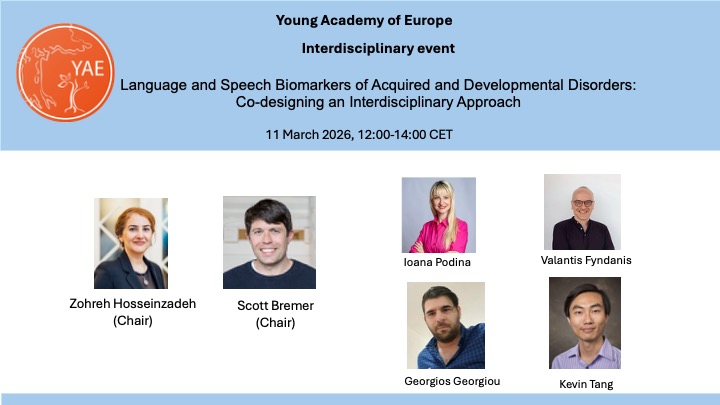
The YAE warmly invites you to an event organised with YAE members, where we will watch and engage with the co-design of an interdisciplinary project in real time, about ‘Language and Speech Biomarkers of Acquired and Developmental Disorders.’ The objective is for people joining the event to both learn about interdisciplinary project design – in theory and practice – and share their own experiences of what has worked for them. We will combine the rich stock of experience among YAE members, and others to build capacity together.
The YAE profiles and advances topics emerging as important in European research; from art-science collaboration to mental health or interdisciplinary for instance. The YAE is a fecund space for interdisciplinary given its members span the full breath of disciplines. We saw this last year when we organised an event to profile work of our members working on topics of language, and put them in dialogue with each other. On this basis we want to take this further, and see how this dialogue could develop into a project.
The programme:
Welcome and introduction: Zohreh Hosseinzadeh An introduction to interdisciplinary: Scott Bremer Co-designing a project: Ioana Podina, Valantis Fyndanis, Kevin Tang, Georgios Georgiou Break Discussion of co-designing the project: All present
Since 2017, the Young Academy of Europe (YAE) Prize has been awarded annually to an early- or mid-career professional in recognition of their outstanding achievements and contributions to key YAE areas (science and policy). In 2019, it was renamed the “André Mischke YAE Prize for Science and Policy” in honor of the late YAE Founding Chair, André Mischke. The prize supports and promotes science, evidence-based policymaking, science communication, and the next generations of scientists and scholars in Europe.
The Prize Search Committee is currently seeking nominations for the 2026 award, marking the 10th edition of the Prize. Please send nominations to yae-prize@yacadeuro.org by 20 March 2026 (prolonged deadline from 28 February 2026). These should include a short CV (max. 2 pages) and a nomination statement (max. 1 page) describing the nominee’s key activities and providing evidence of their relevant accomplishments. Self-nominations are not accepted; nominees must be put forward by European (scientific) organizations (academies or societies). For more information on the nomination process and previous awardees, see this page or the current call for nominations.
The recipient will receive €1,000, and is also expected to deliver a plenary talk at the 2026 Building Bridges Annual Conference of Academia Europaea and the YAE in Budapest (13–15 October 2026) and to contribute a manuscript to the corresponding issue of European Review based on their contributions to European science and policy. PLEASE NOTE: THE DEADLINE IS EXTENDED UNTIL 5PM 20 MARCH 2026.
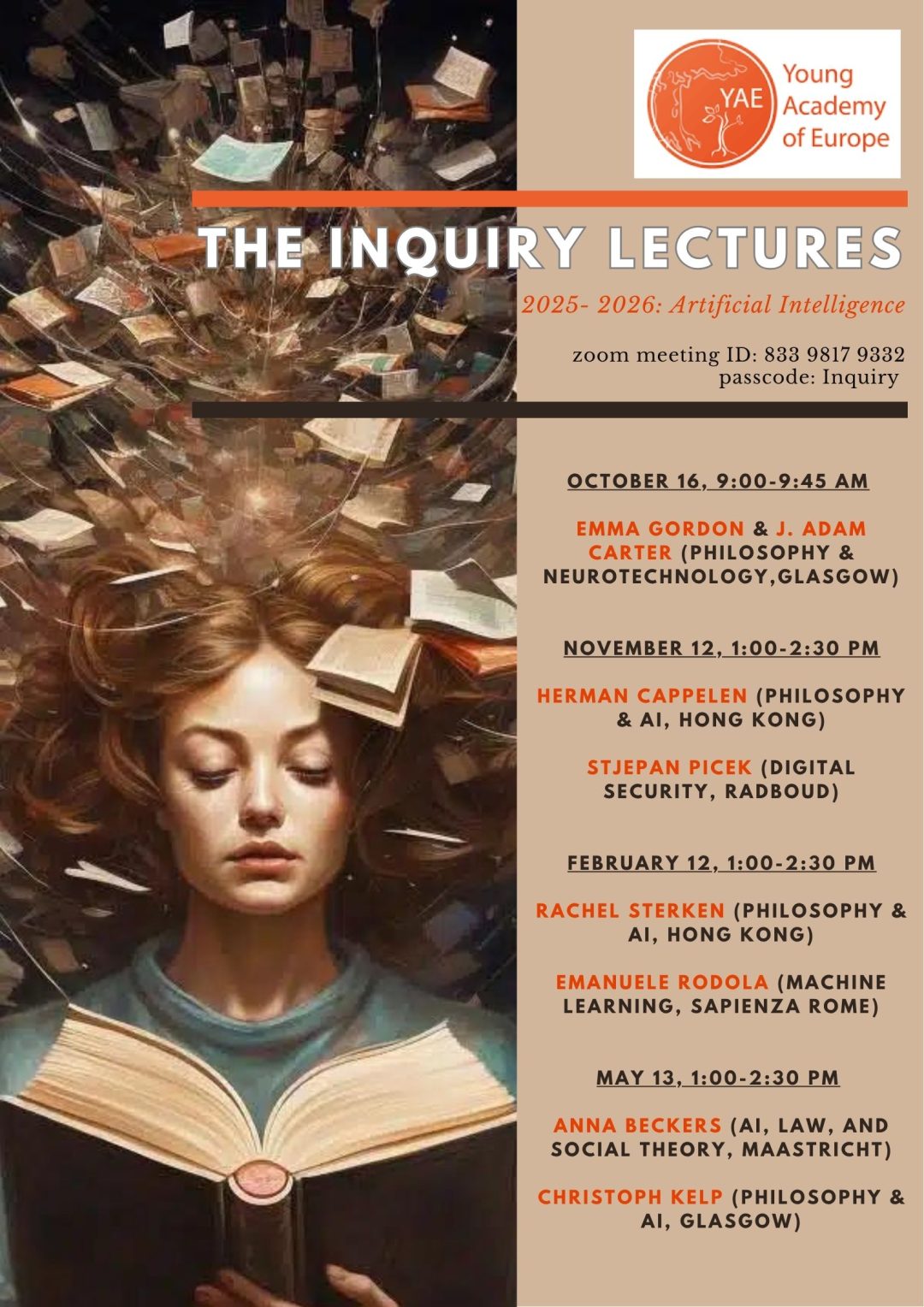
At the AGM in October, the YAE launched a new named webinar series called ‘The Inquiry Lectures’. This year’s theme is Artificial Intelligence.
The next webinar will be on the 12th of February, from 13.00-14.30 CET, when we will have lectures from Rachel Sterken and Emanuele Rodola. The webinar is open to all – not only YAE members. The titles and abstracts for the talks are as follows
LLMs are Candidate Generators Rachel Sterken (work with Alex Radulescu)
When an LLM tells you ‘Paris is the capital of France,’ is it actually saying something, or just producing text that looks like it is? This paper argues that LLMs are best understood as candidate generators: sophisticated systems that produce well-formed text optimized to be useful, but without the beliefs, intentions, or commitments that characterize genuine communication. In a similar manner to the way a chair affords sitting, but the chair doesn’t sit; an LLM output affords asserting, but the LLM doesn’t assert. The real linguistic work happens when you take up that output and make it your own. This talk will chart a middle course between the two extreme positions currently popular. Pessimists dismiss LLMs as “stochastic parrots” mindlessly regurgitating training data, but this undersells their remarkable capabilities. Optimists attribute genuine understanding and beliefs to these systems, but this mistakes impressive engineering for human-like communicative agency and mindedness Our candidate generation framework acknowledges that LLMs produce extraordinarily useful and impressive outputs while maintaining that meaning, truth, and responsibility enter the picture only through human adoption. This isn’t merely an academic distinction: it has real implications for who’s accountable when AI-generated content goes wrong, how we should evaluate these systems, and what we’re actually doing when we interact with them.
Science at Scale Without Scaling Up Emanuele Rodola
Scientific discovery is moving at a pace that is increasingly hard to track. While we have looked to AI to manage this information explosion, current “artificial scientist” models are running into serious technical and ethical barriers. The dominant trend of scaling up has become too expensive and environmentally costly, creating a divide that favors only the most resource-rich institutions. This presentation is going to propose a different path: interoperable machine learning. Instead of building bigger black boxes, we’ll look at how universal representations allow us to repurpose and stitch together existing models. This approach has the potential to make AI more sustainable, democratize research, and ensure that human scientists stay central to the process of creating and verifying knowledge.
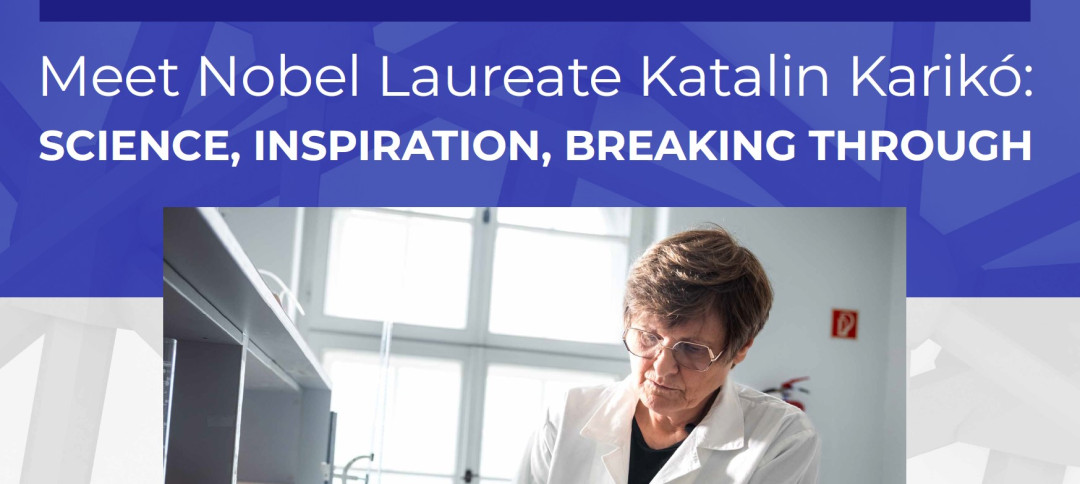
During the Berlin Science Week, an exhibition entitled ‘Forever Forward – Katalin Karikó’ will be put on display at the Hungarian Embassy in Berlin (between 3-14 November, 2025). On the 10 November at 17:00 CET, a STEM TALK event featuring a keynote lecture by the 2023 Nobel Prize laureate in medicine (Prize shared with Drew Weissman) and followed by a panel discussion including members of the Hungarian Young Academy and die Junge Akademie as panellists will be organized at the same venue. Katalin’s scientific journey was highly unconventional, but her meticulous scientific method of literature reviewing or research data management are also highly inspirational for the next generations of researchers. The event is free to attend but requires preregistration at the email address provided on the poster below.
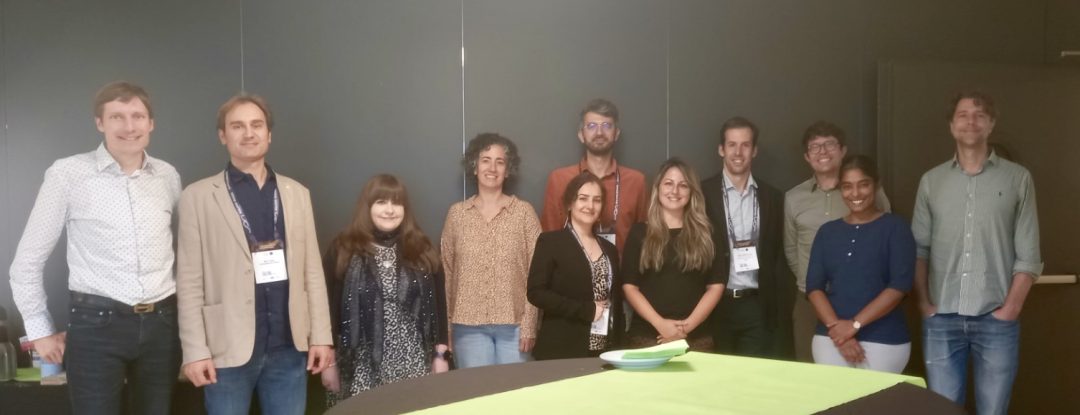
Some of the YAE members attending the AGM on Wednesday 15th October
This year, from the 15th to the 17th of October, the YAE organised its AGM and took part in Academia Europaea’s parallel Building Bridges conference, in lovely Barcelona. While the meetings were somewhat disrupted by strikes – and Autumn colds – we brought together an enthusiastic group, with over 50 members joining physically or online for the sessions on Wednesday.
Board members Zohreh Hosseinzadeh, Niki Liguori, Anna Kuppuswamy and Scott Bremer
As detailed in the programme, Wednesday afternoon, the 15th, the AGM attended to its formal procedures, with a report from the Chair and Treasurer, followed by elections of board members. Votes were tallied up while three YAE members Klass-Jan Tielrooij, Carme Font Paz and Joeri Tijdink presented their on-going research, before the results of the election were presented, and the meeting closed.
Thursday morning, the 16th, was a rich programme of events. It started with Vice-Chair Mona Simion kicking off the YAE’s new ‘Inquiry Lectures’ series, with the inaugural lecture by YAE member Emma Gordon and colleague Adam Carter at the University of Glasgow. Following this, we had a session on ERC Synergy Grants, from Prof. Eystein Jensen – Vice-President of the ERC – and ERC advisor Giuliano Scalzi, with tips on how to put together this form of grant. the AGM finished with a trip to the CRAI Biblioteca de Fons Antic, where we took a tour through some of old texts they have their, including some of the first volumes on anatomy published.
Touring the CRAI Biblioteca de Fons Antic
On Friday the 17th, the YAE co-organised two sessions on the Building Bridges programme. The day opened with Outgoing Chair Scott Bremer and Chair Anna Kuppuswamy presenting the André Mischke YAE Science Policy Prize to Agnieszka Wykowska, and her lecture on ‘Human-Robot Interaction’. Later in the afternoon, the YAE organised a panel discussion on ‘Public Trust in Science and Navigating Political Tensions, with panelists Anna Kuppuswamy, Ruth Rodriguez-Martinez and Emilian Mihailov. This panel sparked lively discussion with the audience, and proved to be a highly interactive session. The aim was to not simply throw up our arms as scientists, and bemoan political interference, but to accept that there has always been politics in science, and learn to adapt as the relation between science and politics shifts.
Presenting the André Mischke prize to Agnieszka Wykowska
At this year’s Annual General Meeting in Barcelona, our members elected a new board. In fact, ten members of last year’s board will remain for another year, which bodes well for retaining continuity and experience on the board for the coming year.
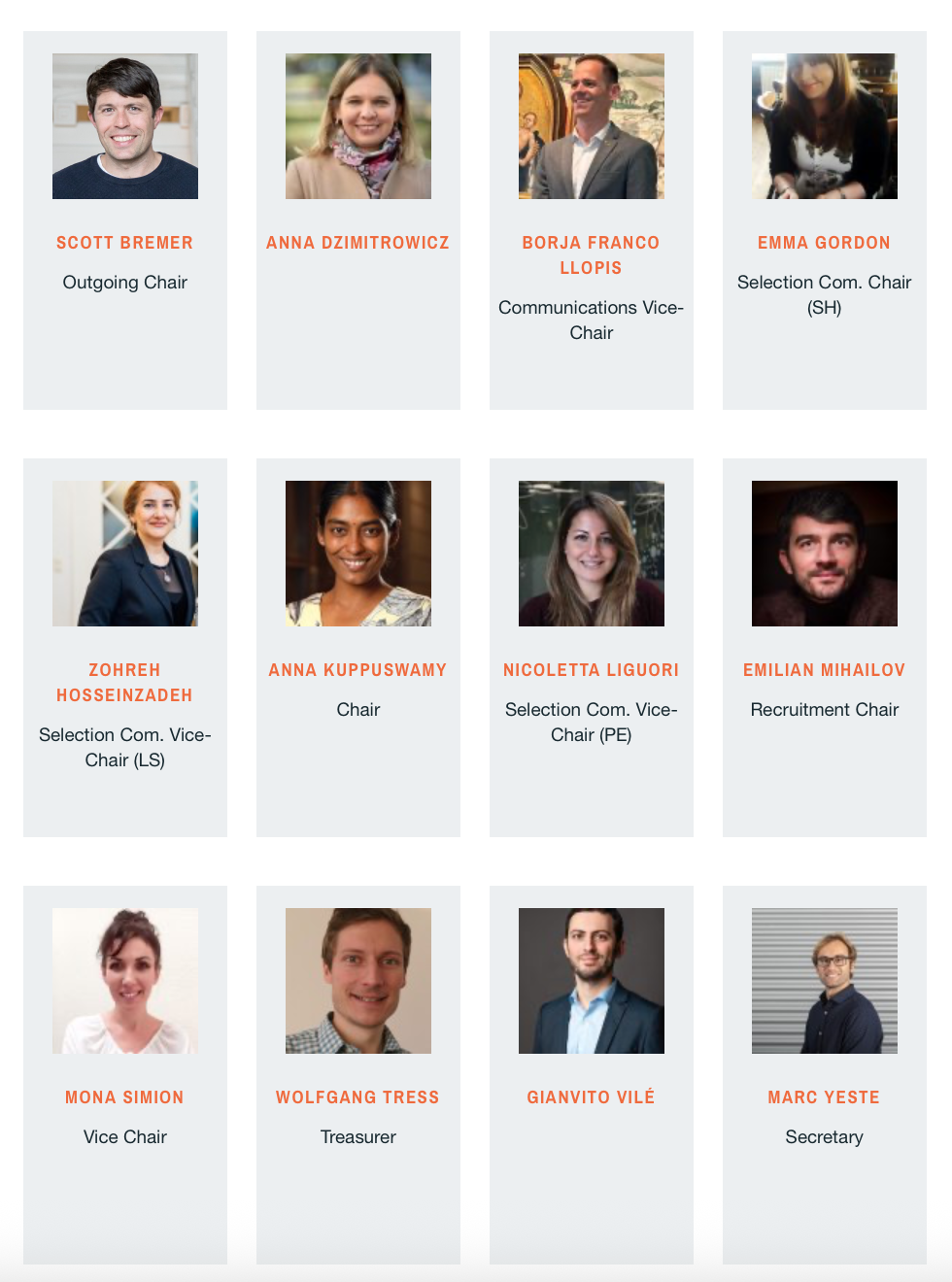
Anna Kuppuswamy was elected as the Chair, and Mona Simion as Vice-Chair, while Scott Bremer moves into the Outgoing Chair position. Two members were voted into the two vacant board positions, namely Anna Dzimitrowicz (working in the PE Domain at the Wroclaw University of Science and Technology) and Gianvito Vilé (working in the PE domain at the Politecnico di Milano).
One of the board positions was vacated by Outgoing Chair Katalin Solymosi. At the AGM, the YAE made special mention of the tireless work of Katalin for the YAE over the past 5 years, where she leaves an important legacy of a grown organisation, that has an even more important voice in the European science-policy and science-for-policy landscape. We will miss Katalin.
The members of the 2025-2026 board are listed in the figure above, and on the website.
We are proud to announce this year’s winner of the André Mischke Prize is Agnieszka Wykowska.
This prize is named in honour of the YAE Founding Chair, André Mischke. It was first introduced in 2017, and is awarded annually to early to mid-career professionals in recognition of their leadership to promote: science, science-policy, evidence-informed policymaking, science communication, and the future generation European scholars.
Prof. Wykowska is internationally recognized for her groundbreaking work in human-robot interaction at the Italian Institute of Technology. But it is her deep commitment to science communication and policy engagement that sets her apart as an André Mischke Prize-winner.
Professor Wykowska’s research has not only advanced our understanding of how humans perceive humanoid robots—culminating in over 90 publications and a Springer-edited book—but has also been translated into real-world applications. She and her team developed a robotic training system for children with autism, implemented in local rehabilitation centers, demonstrating tangible improvements in social skills. This work has gained widespread recognition across national and international media, including ZDF, RAI, BBC, and The New York Times.
Equally impactful is her tireless advocacy for science in public policy. Since her invitation to speak at the European Parliament in 2018, Professor Wykowska has become a key voice in European science policy. As a delegate to the European Research Area Forum, she represents the interests of individual researchers, championing greater support for fundamental science and early-career scientists. Her involvement with the Robert Bosch Foundation and the European Conclave further demonstrates her influence at the intersection of science, politics, and society.
Beyond policy, she actively promotes equity and inclusion in science, participating in high-level panels such as the International Day of Women and Girls in Science, broadcast from the European Commission.
The prize will be presented to Prof. Wykowska at Academia Europaea’s Building Bridges conference on the 17th of October, where she will also give the André Mischke Prize lecture.
This year’s AGM will be held in Barcelona, at the Dr Aiguader Building, University Pompeu Fabra (for more details about the venue, travelling and accomodation see below) and run from 12.30 on Wednesday the 15th of October until 13.00 on Thursday the 16th of October. Registration is €125, and covers all meals including the AGM dinner.
In addition to updates on the YAEs activities and organisation since the last AGM, and electing new board members, we use the AGM as an opportunity for members to network and hear about each-other’s work, to explore ways for the YAE to contribute to European science-policy, and to develop skills in leading innovative research groups. This year we will (i) launch the new Inquiry webinar series , this year on AI; (ii) explore how to develop ERC Synergy Grants; and (iii) have a fieldtrip to a museum on the theme of History of Science.
The AGM is integrated with Academia Europaea’s annual ‘Building Bridges’ conference. You can learn more about Building Bridges, and register (there is separate registration) here. Building Bridges runs from Thursday 16th to Friday 17th October, and YAE members are encouraged to attend this conference after the AGM is over, as it collects together lectures from some of the leading scholars in Europe today. On Friday afternoon, at Building Bridges, the YAE will award the André Mischka Prize, and hold a panel discussion on trust in science, at Building Bridges.
AGM Programme
Start – End
Activity
Speakers/Moderator
Wednesday 15th October 2025
12.30-13.30
YAE AGM opening lunch
Meeting opened by Anna Kuppuswamy (Vice Chair)
13.30-14.30
Welcome and summary of the year. 1. Welcome & update activities 2024/2025 2. Welcome to new FYAEs 3. Treasurers report
Scott Bremer (Chair) Wolfgang Tress (Treasurer)
14.30-14.45
Coffee Break
14.45-15.45
Board elections 1. Pitches of candidates running for elections 2. Electronic voting
Marc Yeste (Secretary)
15.45-16.00
Coffee break
16.00-17.00
Research talks by new members Three talks from new YAE members: Klaas-Jan Tielrooij Joeri Tijdink Carme Font Paz
Nicoletta Liguori (Selection Committee PE Chair)
17.00-17.20
Results of the YAE elections
Marc Yeste (Secretary)
17.20-18.30
Aperitif
19.30-21.30
AGM dinner
Start – End
Activity
Speakers/Moderator
Thursday 16th October 2025
09.00-09.45
Launching the Inquiry webinar series An opening talk for this years series on the topic of AI, opened by YAE member Dr. Emma Gordon.
Mona Simion (Comm. Chair)
09.45-10.45
What is an ERC Synergy Grant, and how to apply? A presentation by ERC Vice-president Prof. Eystein Jensen and ERC Synergy advisor Giuliano Scalzi, followed by workshopping a synergy idea put forward by YAE members.
Anna Kuppuswamy (vice chair)
10.45-13.00
Field trip and lunch A guided tour of historic academic texts at CRAI Biblioteca de Fons Antic, followed by a discussion on how interdisciplinarity and science-art collaboration was understood in the past.
Borja Franco (Comm. chair)
The venue: Day 1: Faculty of Medicine, University Pompeu Fabra. Edifici Dr. Aiguader (campus del Mar) Doctor Aiguader, 80 08003 Barcelona Room: 61.119
Day 2: Seminario de la Sección de Prehistoria y Arqueología” (First floor, Facultat de Geografía e Història, Carrer de Montalegre, 6)
More precise instruction on reaching the venue will follow.
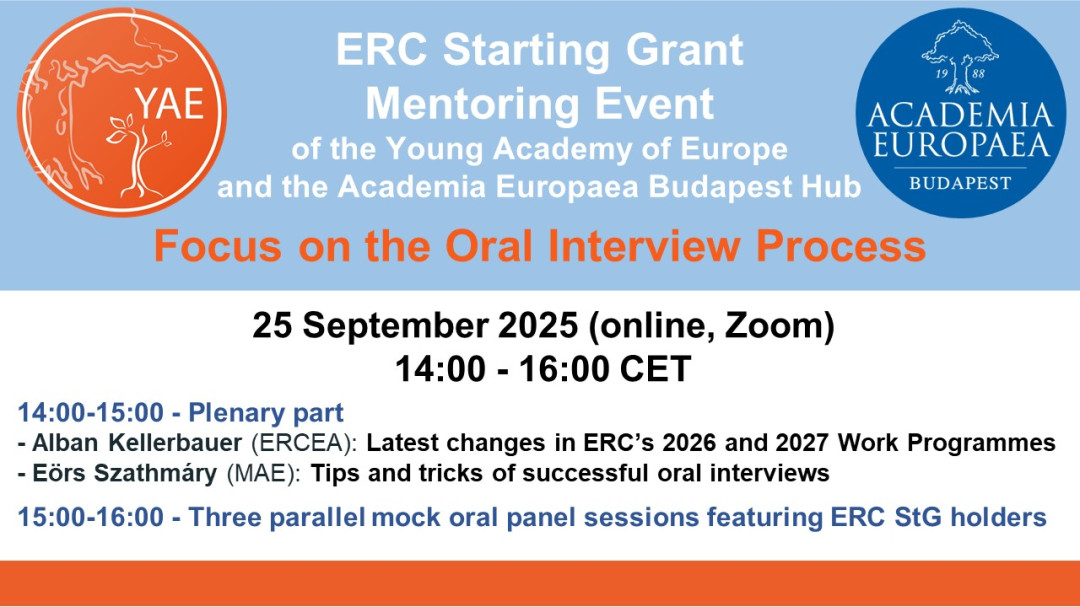
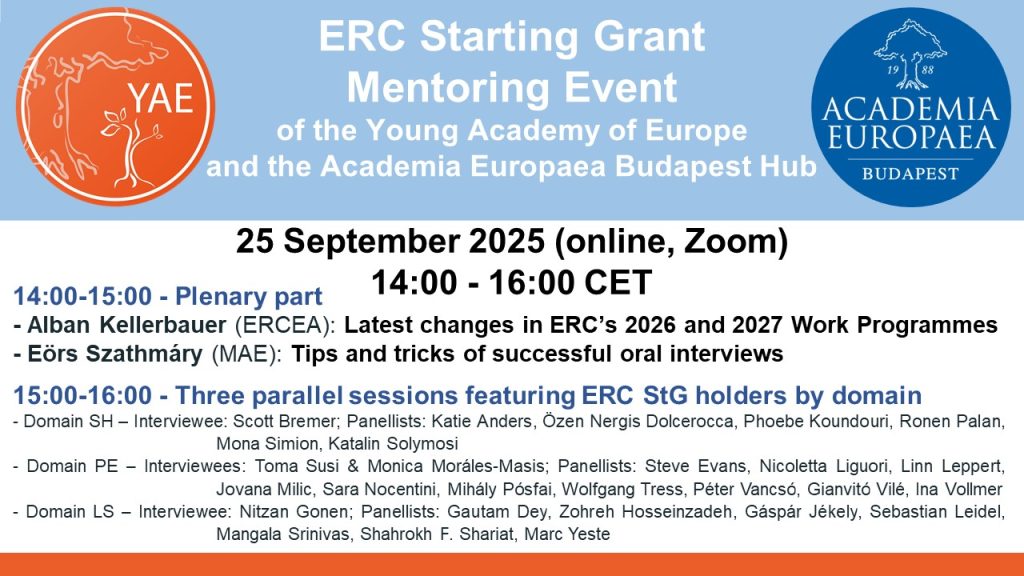
On September 25, 2025, from 14:00 to 16:00 CET, the Young Academy of Europe (YAE), in collaboration with the Academia Europaea (AE) Budapest Knowledge Hub, hosted an online event on Zoom for researchers worldwide who are interested in applying for the next round of the European Research Council’s (ERC) Starting Grant (StG). One of the main goals of this event series is to promote wider participation among researchers from EU13, Associated Countries as well as outside of Europe.
The online event consisted of two parts. First, a plenary information session was held with welcoming remarks from Katalin Solymosi (Outgoing Chair, YAE and Vice Academic Director, AE Budapest Hub) followed by a presentation from Alban Kellerbauer (FYAE, MAE, Head of Unit ‘Support to the Scientific Council’, ERC Executive Agency) about the latest changes in ERC’s 2026 and 2027 Work Programmes. The presentation was followed by a Q&A session moderated by Anna Kuppuswamy (YAE Vice-Chair). Finally, in a prerecorded pitch, Eörs Szathmáry (MAE, ERC Advanced and Synergy Grant Holder, former ERC Advanced Panel member and Synergy Panel Vice-President, Parmenides Foundation, Eötvös Loránd University) provided useful tips and insights for ERC oral interviews.
The second part of the event focused on providing insights into how oral interview panels work and how interviewees should present their project and answer questions from the evaluation panel. Although these were only mock interviews and panels, we believe that they offered an important opportunity for applicants to gain key insights into what makes a successful ERC application and a better understanding of the evaluation process. We had three parallel sessions by domain, featuring as interviewees YAE members who have received an ERC StG, and expert panel members with relevant expertise in oral interview evaluation.
Programme
Plenary session (14:00-15:00 CET)
14:00-14:05 Opening (Katalin Solymosi, YAE and AE Budapest Hub)
14:05-14:30 Information session, The European Research Council (ERC): Latest changes in ERC’s 2026 and 2027 Work Programmes (Alban Kellerbauer, ERCEA, FYAE, MAE)
14:30-14:45 Q & A
14:45-15:00 Tips and tricks of successful oral interviews (Eörs Szathmáry, MAE)
Moderator: Anna Kuppuswamy (YAE)
Parallel break-out sessions (15:00-16:00 CET)
1. Social Sciences and Humanities (SH) domain specific mock oral panel – interviewee: Scott Bremer (ERC StG obtained in 2018, panel SH2, Project title: CALENDARS – Co-production of seasonal representations for adaptive institutions). Panel members: Katie Anders (University of Bergen), Özen Nergis Dolcerocca (FYAE, University of Bologna), Phoebe Koundouri (MAE, Athens University of Economics and Business), Ronen Palan (City University London), Mona Simion (MAE, FYAE, University of Glasgow), Katalin Solymosi (FYAE, Eötvös Loránd University).
2. Life Sciences (LS) domain interviewee: Nitzan Gonen (ERC StG obtained in 2021, panel LS2, Project title: ENHANCE-SEX – Deciphering Gene Regulatory Networks governing Mammalian Sex Determination). Panel members: Gautam Dey (FYAE, EMBL), Zohreh Hosseinzadeh (FYAE, Radboud University Medical Center), Gáspár Jékely (MAE, COS Heidelberg University), Sebastian Leidel (MAE, FYAE, University of Bern), Mangala Srinivas (FYAE, Wageningen University and Research), Shahrokh F. Shariat (MAE, Medical University of Vienna), Marc Yeste (FYAE, University of Girona).
3. Physical Sciences and Engineering (PE) domain interviewees: Toma Susi (ERC StG obtained in 2017, panel PE5, Project title: ATMEN – Atomic precision materials engineering) and Monica Morales-Masis (ERC StG obtained in 2019, panel PE8, Project title: CREATE – Crafting Complex Hybrid Materials for Sustainable Energy Conversion). Panel members: Steve Evans (MAE, University of Cambridge), Nicoletta Liguori (FYAE, IFCO), Linn Leppert (FYAE, University of Twente), Jovana Milic (FYAE, University of Turku), Sara Nocentini (FYAE, LENS), Mihály Pósfai (MAE, University of Pannonia), Wolfgang Tress (FYAE, Zurich University of Applied Sciences), Péter Vancsó (Centre for Energy Research, HUN-REN), Gianvito Vilé (FYAE, Polytechnic University of Milan), Ina Vollmer (Utrecht University).
We are grateful to all our members and alumni as well as the external experts involved in the panels (as moderators, interviewees or panelists) who made this well attended event happen. The event was organized by Katalin Solymosi (YAE and AE Budapest Hub) with help from the YAE Board, and the AE Budapest Hub (Katalin Borvölgyi and Nóra Deák).
Registration was open on this link. This was the text we shared with participants who registered to the event. “By registering for this event, you agree to the session being recorded on Zoom. Please note that we do not send separate registration confirmations, but the Zoom link will be emailed to registered participants a few days before the event. The registration form collects your data solely to manage attendance for the webinar. By registering, you consent to YAE’s Privacy Policy and Data Protection Policy as described here.“
A second YAE podcast featuring the 2023 André Mischke YAE Prize for Science and Policy awardee, Professor Renaud Jolivet has been published on YAE’s YouTube channel. The podcast interview is a longer version of the written interview available here.
In 2023, at the Annual General Meeting of the Young Academy of Europe (YAE) and the joint YAE and Academia Europaea Building Bridges Conference in Munich, YAE awarded the André Mischke YAE Prize for Science and Policy to Professor Renaud Jolivet from Maastricht University. The award ceremony and his lecture can be viewed here (starting at 03:17:04), as well as on our homepage. Professor Jolivet later summarized his talk at the Building Bridges Conference 2023 in Munich in a paper entitled “Lessons from a First Decade in European Science Policy”, published in European Review and freely available at the following link. On this occasion, Katalin Solymosi, the Chair of the YAE interviewed the awardee about his scientific and science policy related activities, goals, and visions.