Prof. Verhelst is working in microelectronics and chip design, pioneer in custom AI processors, and is head of a research team at the MICAS laboratories (MICro-electronics And Sensors) of the Electrical Engineering Department of KU Leuven, Belgium. For her successes in research, she received numerous awards, prizes, fellowships, and grants including the Laureate of the National Academy of Science and Arts in Belgium, ERC Starting Grant, Fellow of the European Laboratory for Learning and Intelligent Systems (ELLIS), an IEEE distinguished lectureship, and grants from industry (e.g. Intel, Qualcomm, Huawei, Nokia). Verhelst has been involved in various organizations and activities, e.g. for the enhancement of science literacy and a larger uptake of STEM studies as member of the Flemish STEM platform, and to improve possibilities, work-life balance and the science landscape for early-career researchers as founding member of the Belgian Young Academy, where she served on the Board and as co-president for two years. Verhelst is also passionate about science communication, especially towards young people and girls. She founded the Innovation Lab which develops engineering projects ready to be executed in secondary schools, with currently six projects in its portfolio, having trained over 600 teachers, who have executed the projects with more than 12 thousand students. She also features regularly on popular science TV shows (The body of Coppens) and podcasts (Nerdland), reaching hundreds of thousands viewers/listeners. She was involved in the creation of citizen science portal in Belgium, was chosen in the 2020-2022 Science meets Parliament programme, and initiated and organizes the “Women in circuits” initiative in the IEEE Solid State Circuits Society for mentoring young female chip researchers.
By awarding her the YAE Prize, the YAE recognises internationally leading academic research, management, and policy making. The YAE will award the fifth annual YAE Prize, honouring our Founding Chair André Mischke, at the joint annual AE /YAE meeting in Barcelona (October 2021).
This year’s AGM will be held in Strasbourg, at I.S.I.S. (for more details about the venue, travelling and accomodation see below) and run from 12.30 on Monday the 26th of August until 16.00 on Tuesday the 27th of August, hosted by colleagues at CNRS.
In addition to updates on the YAEs activities and organisation since the last AGM, and electing in the new board, we use the AGM as an opportunity for members to network and hear about each-other’s work, to explore ways for the YAE to contribute to European science-policy and science-for-policy, and to develop their skills in leading innovative research groups. This year we will continue our focus on how scientific research can be represented in engaging and creative ways with the creative arts, and round up this year’s thematic webinar series on mental health with a whole-afternoon session on empathetic research leadership.
Here you can register for the AGM through the Eventbrite registration system. If you require a more detailed invoice you can request one by emailing office@yacadeuro.org. Please note that closer to the AGM all registered participants will be sent more detailed information on the meeting, and how to find the venue.
Below you can find the AGM programme. It will be updated as detailed plans come together and speakers confirm their availability.
We look forward to seeing you in Strasbourg this August for an enriching meeting.
Venue of the event is the Institut de Science et d’Ingénierie Supramoléculaires (I.S.I.S), ISIS-2 meeting room, I.S.I.S.-2 building 2nd floor, Pick-up point I.S.I.S. reception desk in the building from where we’ll be guided to the meeting room. 8 allée Gaspard Monge FR-67083 STRASBOURG Cedex
How to reach the I.S.I.S. – the building is located 15 to 20 minutes from Strasbourg railway station. You need to take Tram C – Stop « Gare centrale » – Direction Neuhof Rodolf Reuss, leave the tram at “Universités” (15 min). Walk along the building “INSA”. Take the first right “Rue Gaspard Monge”. At the end of the road on the right you will find the ISIS building (5 min).
The AGM dinner will be in Restaurant Maison de Kammerzell (Adresse: 16 Place de la Cathédrale, 67000 Strasbourg, Phone : 03.88.32.42.14). You can reach the restaurant by Tram C from ISIS or the hotel – Direction “Gare centrale” – Stop Homme de Fer. Then walk to the cathedral (5 minutes).
For more detailed information about transportation see this pdf.
The following hotels have been suggested by the host partner as they are close to the university. The hotels are on the tram line leaving the railway station going to the university, the Lufthansa bus stop is next to the railway station.
On March 15th, the peer-mentorship exchange platform PEP-CV (https://pep-cv.mariecuriealumni.eu/) officially launched, providing a space for creating mentorships to support the writing of narrative-style CVs. This initiative is a collaboration between six research funding agencies, the Marie Curie Alumni Association, and the Young Academy of Europe to provide support for the global research and innovation community in presenting the diverse set of experiences, achievements, and careers in the format of narrative-style CVs.
Sean Sapcariu (FNR, Luxembourg) presents the PEP-CV platform at the MCAA Annual Conference
PEP-CV is a free and open resource for everyone in the Research & Innovation sector, buttressing existing guidance on narrative-style CVs, while supporting efforts to further develop their use and implementation globally. To this end, the PEP-CV platform aims to support the broader recognition of activities and outputs in research, in line with ongoing responsible research assessment initiatives such as the Declaration on Research Assessment (DORA) and the Coalition on Advancing Research Assessment (CoARA).
PEP-CV will be an open resource to bring the community together and provide peer-mentoring
Many funders and institutions around the world use narrative-style CVs, but feedback from researchers underscores the need for more guidance and understanding of what a “good” CV looks like. As a CV is highly dependent on the experiences, achievements, and expertise of the writer, the ideal CV should be personalized and unique to the individual. Individual peer-to-peer mentoring on how to select and present achievements and experiences is, therefore, the ideal next step to augment currently available resources and support individuals in evaluations they face in their career.
PEP-CV is a platform to support the ongoing adoption of narrative-style CVs found across the globe through fostering peer-mentorship activities, and to provide space for discussion around a broader range of career pathways and research outputs to ensure they are adequately articulated in narrative-style CVs. It is open to everyone in the research and innovation ecosystem and is based on the values of collaboration, openness, collegiality, diversity, and inclusion.
The platform is a collaboration between six funding agencies (FNR, NWO, SFI, SNSF, UKRI, Wellcome) and two researcher groups (MCAA and YAE). The funders involved already require narrative-style CVs in their funding programmes, and these countries have researchers who can already contribute to PEP-CV as mentors. As more researchers write and evaluate a broader set of achievements and experiences, more mentors will join and help grow the platform.
PEP-CV will benefit mentees, mentors, and supporting institutions
The PEP-CV platform
Through fostering mentorship exchanges, PEP-CV will provide added value for mentors, mentees, and supporting institutions. Mentors will engage in global networking and mutual learning through their activities, while building their CV and mentorship experience. Mentees will learn to write a more effective narrative-style CV, highlighting the strengths of their individual profiles and receiving insight from experienced colleagues. Both mentors and mentees will be fostering a more equitable, diverse, and inclusive research and innovation environment.
Institutions supporting PEP-CV through promotion and financial support will enhance their reputation and credibility around responsible research assessment practices as well as demonstrate the fulfilment of CoARA commitments. In addition, they will help support staff in developing their narrative-style CVs, recognizing their broad contributions to the research and innovation ecosystem and making it more inclusive.
PEP-CV aligns with ongoing initiatives in responsible research assessment, including CoARA and DORA
Initiatives such as DORA and CoARA strongly advocate for the recognition of a broader range of activities and contributions to research, and the narrative-style CV is currently one of the ideal forms for an individual to showcase these diverse outputs and activities. PEP-CV is a resource that individuals and institutions can use to evidence their support for responsible research assessment and the importance of recognizing a broader range of outcomes and activities in research and innovation. In addition, PEP-CV contributes to the use of the narrative-style CV formats across different research and innovation ecosystems, simplifying the transition or supporting existing resources.
Read about our next events and future plans including the first webinar of our academic mental health related webinar series, our upcoming AGM, the Building Bridges 2024 Conference, as well as the science policy related activities of our collaborating partners in our February 2024 Newsletter. The February Newsletter was prepared by Scott Bremer (YAE Vice-Chair) and Katalin Solymosi (YAE Chair) and was approved by the Board.
If you would like to receive our newsletters, please subscribe. You can unsubscribe from these emails at any time by contacting us at office@yacadeuro.org. For more information on how we process and secure your data, please view our Privacy Policy.
This years’ YAE webinar series focuses on mental health. In the competitive and demanding world of academia, pursuing knowledge and academic excellence often comes at a price – the mental well-being of academics. To address this crucial aspect of academic life, and break the stigma around mental health, we present a three-part webinar series dedicated to the mental health of early and mid-career researchers and academics.
The first webinar will be on Monday the 25th of March, from 14.00-15.00 CET, on Zoom. Sign up here:
Webinar 1: “Navigating academic pressure: Strategies for self-care and well-being”
25 March 14.00-15.00 CET (On Zoom)
This webinar explores strategies for we as individuals to thrive in academia without compromising our mental health. Two expert speakers will discuss (among other things) approaches to time management, setting boundaries, stress reduction techniques, and the importance of work-life balance, tailored to young academics’ unique challenges. It will also be an opportunity for attendees to share their own strategies.
Bernadette Kun (Eötvös Loránd University, Hungary): Risk Factors of Work Addiction
The issue of work addiction can impact individuals across various professions, including academia. Personality traits, socio-demographic characteristics, motivations, organizational aspects of the workplace, and other factors may contribute to this phenomenon. All of these factors underscore the heightened susceptibility to work addiction among those employed in academia. The presentation will elaborate on these factors and also propose treatment options.
Darragh McCashin (Dublin City University, Ireland): Mental health in academia – what we know and what we can do.
There have been growing concerns over the sustainability of academic careers due to increasing mental health difficulties. This talk discusses the experience of the ReMO COST Action, with reference to how mental health has become a hot topic at individual, institutional, and policy levels. We will discuss what the evidence indicates, and what individuals can do to address this issue.
The Initiative for Science in Europe Working Group for Research Careers led by Mona Simion (Recruitment Chair of YAE) has been tasked with identifying funding schemes in Europe that promote job stability and security for postdoctoral researchers, in all career stages. To this aim, the ISE (and its member organisations including the International Consortium of Research Staff Associations – ICoRSA) prepared a short survey to identify funding schemes that promote research stability. The deadline is February 15, 2024 and it will only take 5 minutes of your time. Please also feel free to share it in your network. Although the exercise is to contribute to European landscape, it may include international funding schemes as a way to collect best-practices.
Read about our recent activities, events, surveys and latest developments in our January 2024 Newsletter. The January Newsletter was prepared by Scott Bremer (YAE Vice-Chair), David Fernandez-Rivas (YAE Communications Chair) and Katalin Solymosi (YAE Chair), and was approved and complemented by the YAE Board.
If you would like to receive our newsletters, please subscribe. You can unsubscribe from these emails at any time by contacting us at office@yacadeuro.org. For more information on how we process and secure your data, please view our Privacy Policy.
Interview with Prof. Renaud Jolivet, awardee of the André Mischke YAE Prize for Science and Policy in 2023
In 2023, at the Annual General Meeting of the Young Academy of Europe (YAE) and the joint YAE and Academia Europaea Building Bridges Conference in Munich, YAE awarded the André Mischke YAE Prize for Science and Policy to Professor Renaud Jolivet from Maastricht University. The laudatio of the awardee and his talk can be viewed here (from 03:17:04), as well as on our homepage. On this occasion, Katalin Solymosi, the Chair of the YAE interviewed the awardee about his scientific and science policy related activities, goals, and visions.
Prof. Renaud Jolivet delivering his speech at the Academia Europaea and YAE Building Bridges Conference in Munich, 2023
Katalin Solymosi: First, I would like to congratulate you Renaud for the Prize, which was named after the first Chair of the YAE, the late André Mischke, and which is relatively unique in its aim to recognize researchers who are excelling both in science and in science-policy at an international level. In this interview we will hear a little bit about how you came to work in science-policy, and some of your ambitions for science-policy.
Renaud Jolivet: Thank you, Katalin, for this opportunity.
K.S.: As a first question, could you describe your background? How did you come to be a researcher and which twists and turns took you to this point in your career?
R.J.: I grew up in Switzerland, and studied physics first, then neuroscience. After that, I did almost a decade of postdocs in Switzerland and in the UK with research stays in Japan, before landing my first faculty job back in Switzerland. After almost 6 years in Switzerland, I had two offers to move abroad again, and moved to Maastricht University, where I am currently Full Professor and Chair of Neural Engineering & Computation.
I cannot remember how or when I decided to become a researcher. I am a first generation academic. No one around me had gone to university or knew how to become a researcher. It was thus not the most obvious path, but I was an avid reader of science fiction, and then later of popular science books, and so it seemed natural to me at an early age to want to become a physicist. I also grew up close to CERN, which at that time organized regular science outreach evening lectures, and my parents drove me there on several occasions. By chance, higher education is easily accessible in Switzerland.
K.S.: You gave an excellent and inspiring talk at the Building Bridges Conference about your research related to the neuronal network in the brain. How did you choose neurobiology as your main topic?
R.J.: I did not. I wanted to work at the interface between physics and biology, and accidentally fell into neuroscience.
K.S.: What are the most important scientific questions you have worked with or intend to work with in the future?
R.J.: For me there is today one central question in neuroscience, what is the role in physiology and pathophysiology of non-neuronal cells? We probably have a decent understanding of how neurons operate and communicate. By contrast, we know far less about non-neuronal cells, despite mounting evidence that they are crucial for understanding the brain. I am convinced that this is the great question of our time in neuroscience. There is also an interesting link to AI here, as we know what the brain is capable of, but we fail to understand how neurons and non-neuronal cells contribute together to learning and cognition. I think that if one would at least partially solve that conundrum, this could lead to better performing AI systems, which for now mostly mimic the brain as a big neural network. This and other related questions form a relatively new subfield that is called NeuroAI.
K. S.: If you had all the money, instrumentation, and staff necessary to do it – which scientific question would you try to answer first?
R. J.: If I had all the money and resources in the world, I would create in Europe a large research center at this interface between neuroscience and AI, which would embrace the brain in all its complexity rather than seeing it merely as a big neural network. I personally believe that it is unavoidable for the field to move into this direction, and I am concerned that Europe is not being more proactive about this, while our competitors in North America and China have already taken steps towards such initiatives. I have been calling for the creation of such a center in various fora, so far without success, but these things never happen overnight.
K.S.: I hope that your voice will be heard! Now, let’s move from pure science to science-policy. What was your major motivation to become involved in science policy? What is your experience in this field?
R.J.: As a first-generation academic, I promised myself as a postdoc that if I ever made it to a faculty position, I would invest some of my time mentoring early-career researchers. This was driven by the realization that being a first-generation academic comes with its own set of struggles and challenges if no one helps you navigate the unwritten rules of academia, which was the case for me. Because of this, I got involved ten years ago in the Marie Curie Alumni Association (MCAA) and have been mentoring ECRs over the last 5 years. Then, however, this parallel career took on a life of its own. I went on to serve in the board of MCAA, in the board of the Initiative for Science in Europe (ISE), and later was appointed by ISE, MCAA and other like-minded organizations to represent individual researchers and innovators in the European Commission’s European Research Area (ERA) Forum. Finally, I was appointed very recently as a Fellow of the International Science Council, and I am looking forward to continuing this parallel career at the international level.
K.S.: It was a nice thought and motivation from you to want to help the next generation of researchers. I know how much work it is to be involved in the above organizations, and that it comes with various types of activities or streams of work. What do you consider to be your most important achievement in science policy?
R.J.: There are two achievements that I consider important. First, MCAA started a mentoring program. I played a small part in that, as this was a proposal that Marco Masia and myself put forward already in 2017, and it took a few years to concretize. Second, our organization’s being invited to send a representative to the ERA Forum was the result of a lot of work by numerous people over the years, and I am proud to have contributed a small part to this. The ERA Forum matters, because it is today the high table where the European Commission, the Member States, and stakeholders, shape the future of European science.
K.S.: If you could reform one thing in the academic landscape – where would you start? What is the most challenging issue?
R.J.: There are many areas where academia obviously needs reforming. A lot of excellent work is currently done in Europe within the Coalition for Advancing Research Assessment (CoARA). There is one area that I see less often discussed however, and I’d like to focus on that here. In my work at the ERA Forum, I have come to realize that I am probably the only active scientist around the table, and among the few attendees who have actual research experience. This is not to be construed as a criticism of my colleagues within the Forum, who really have at heart to do what’s best for Europe, and bring to the table expertise that few scientists, if any, have. I do feel, however, that we lack in Europe better integration between scientists and the government level. By contrast, I think that this is done relatively well in North America, with big scientific institutions such as the National Institute of Health (NIH), where the Director might be called to report directly to the White House. Institutions such as the NIH, led by scientists, really cross the divide between performing science, funding science, and shaping science policy. I don’t believe that we have anything similar at the EU level, and I really think we should.
K.S.: As someone working as a professor and an independent PI and also involved in so many science policy related activities, I am really curious to know how you manage a work-life balance…
R.J.: Now, my work-life balance is quite good, even though I do very many different things in parallel (teaching, leading a research group, participating in some of the management tasks of our department and faculty, service and committee work in my research community, and service and committee work in science policy). This was not always the case, however. As a postdoc, I struggled to take a break from my work. I am afraid this is inherent to that career stage in very competitive fields like mine. I am not quite sure how that can be changed if many more people enter postdoctoral careers than available junior faculty positions. In that sense, tenure does make your life easier.
K.S.: Do you have any tips you could share with your peers or postdocs struggling with work-life balance and time management?
R.J.: I have a few tips, or rather a system. As academics, we are increasingly asked to take on more and more diverse tasks. In my opinion, not all are necessary however, and if you are a group leader, you can probably delegate a lot of them to your team. Obviously, you need to pay attention to your team members’ workload and career progression, and not overload them with work that does not benefit their career. My system is as follows. First, I am trying to develop the instinct to say no to as many requests as possible. Second, I ask myself whether someone in my team can do that task and learn something from it, in which case I delegate that task to them. Third, I aggressively manage my time. I keep track of where my time goes every day in a big spreadsheet, and I regularly review the aggregated time I have spent on various tasks, and how it compares to what I get out of them. This last point is essential in my opinion, as otherwise you run the risk of losing lots of time in unproductive or unnecessary tasks. This has also helped me develop a sense for when you have spent enough time on a task so that it is done well, although maybe not perfectly. Lastly, I have learned that certain things happen on their own time, no matter how much you would like them to go faster, and sometimes you can only wait.
K.S.: Thank you very much, Renaud, for the interview, and on behalf of the YAE we wish you all the best for your scientific and science policy related activities.
Later a longer, podcast version of this interview has been also recorded and published on our YouTube channel. For more details see here or on the link below. The European Review paper by Prof. Jolivet summarizing his award talk and antitled “Lessons from a First Decade in European Science Policy” is freely available at the following link.
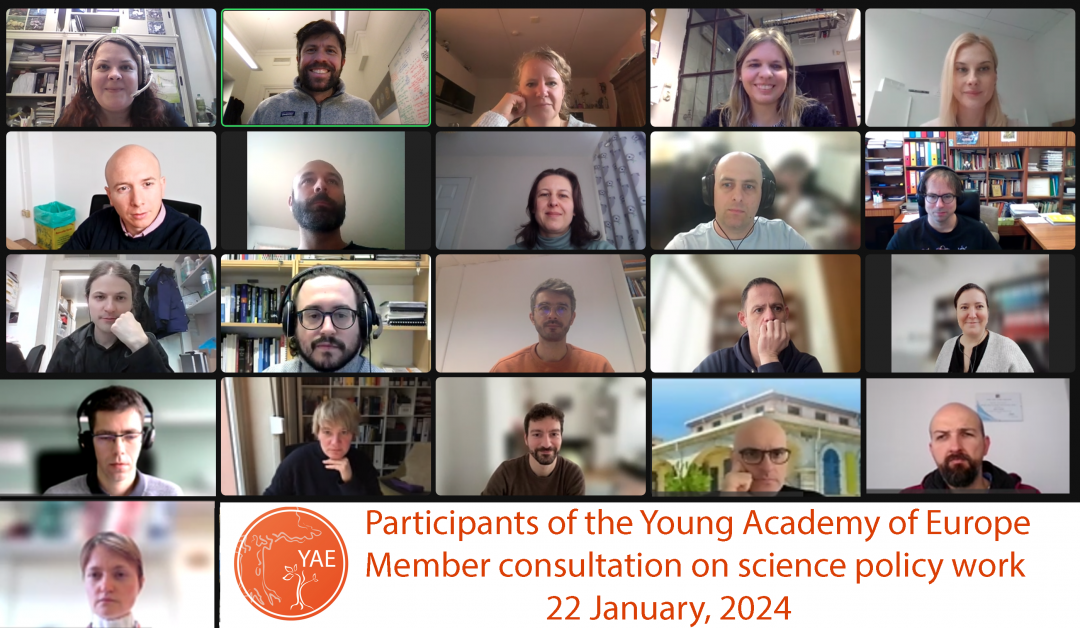
On 22 January, 2024, we held a highly insightful and well-attended member consultation on the various science policy related activities of the YAE. On the event moderated by Scott Bremer (YAE Vice-Chair), Moniek Tromp (Outgoing Chair) and Katalin Solymosi (YAE Chair) presented how YAE is actually involved in the European Science Advice Mechanism (via YASAS and SAPEA), in science policy related work at the European level (e.g. in collaboration with Academia Europaea, the Initiative for Science in Europe, the Marie Curie Alumni Association, Eurodoc and the International Consortium for Research Staff Associations, as well as with European national young academies) as well as globally (within the International Science Council). Our involvement in the development of a peer-mentoring platform for narrative CVs, and in various working groups of the Coalition for Advancing Research Assessment (CoARA) were also discussed. If you could not attend the event or would be interested to join YAE’s activities in science advice for policy or in science policy, please do not hesitate to contact us on chair@yacadeuro.org, and to join the YAE Discord channel on which we may exchange ideas on these topics.
Academic freedom is the basis for reliable, trustworthy research and education, and is a crucial core principle also for early and mid-career researchers. As a follow-up of the meeting of the European Network of Young Academies (ENYAs) in May 2023, where YAE was represented by Anna Kuppuswamy (Selection Committee, Vice-Chair), the YAE signed the Stockholm Charter on Academic Freedom which has been launched on 24 January 2024.
The Young Academy of Europe Prize is awarded annually to an early to mid-career professional in recognition of their outstanding achievements and contributions to key areas of the YAE. In 2019, the YAE Prize was named “André Mischke YAE Prize for Science and Policy” in honour of the late YAE Founding Chair, André Mischke. The prize is given to support and promote: science, evidence-based policy making, science communication, and future generation scientists and scholars in Europe.
Currently, the search committee is looking for nominations for the 2024 award. Nominations should be sent to yae-prize@yacadeuro.org by the 15th of March 2024 at the latest, and should include a short CV (max. 2 pages) accompanied by a short statement (max. 1 page) describing key activities and providing evidence of relevant accomplishments for which the candidate is nominated for. (Please note that the original nomination deadline of 29th February has been extended!) See more information here.
Based on their contributions to European policy and science, the recipient of the award is expected to give a talk at the AE/YAE Annual Conference and to contribute a paper to the issue of European Review published on the same occasion.