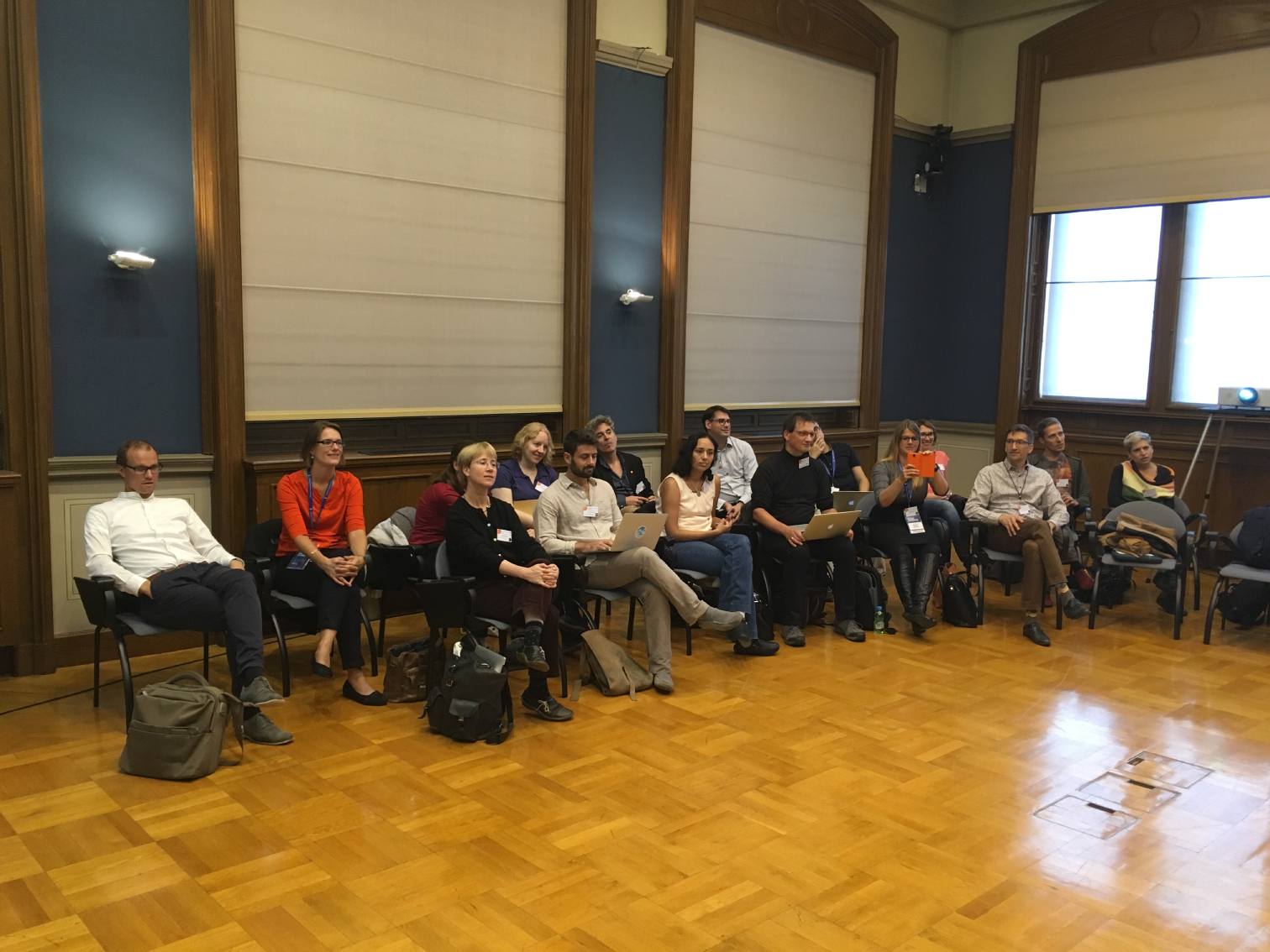
First YAE event of 2021: a brainstorming session on ‘Bridging the gap in knowledge on animal experimentation’ was held online on 12 February.
The topic of animal experimentation is highly controversial and generates strong opinions and emotions. As for many other controversial topics (environmental changes, genetic manipulation, use of technology to control the mind and the body, etc.) it is of fundamental importance that people form their opinions upon robust, verifiable and actual information.
In particular now, at a time when many governments are taking decisions that will determine how bio-medical experiments can be performed, offering transparent information on common praxis and regulation in these fields is important.
From 2021 we therefore aim at developing a series of webinars aimed at assembling and disseminating robust, verifiable and actual information about some of these controversial topics, starting with animal experimentation. We think that this topic can be of interest to YAE members across all diverse disciplines and backgrounds and we encourage broad participation, not only from those working in the life sciences.
As an initial step toward the development of the webinar structure, we organized a brainstorming session on “Bridging the gap in knowledge on animal experimentation”.
The aims of the brain storming was to:
1) Develop and Plan a series of webinars that would discuss goals, regulations, benefits and caveats, and alternatives to animal research in different Life Science fields. During the brainstorming session we welcomed thoughts on what information people need to make well informed decisions, on which information is already available in different formats, on the ways to make information available to different publics, and look for volunteers ready to take part in this activity
2) Identify ways to understand what questions people have about animal experimentation and what kind of information they can currently access. Ideally, we’d like to perform a survey of publics that measures the level of knowledge around animal research, but there may be other approaches. We are particularly interested in finding out what the public does (and does not) know about animal welfare and regulations governing the ethical use of animals in research. During the brainstorming session we welcomed feedback on how to perform such research. YAE members from social sciences and humanities would be particularly welcomed to give their input.
This year, due to the current COVID-19 pandemic, our yearly annual general meeting (AGM) was held online, on 20th October 2020. It was an inspiring and lively meeting, inclulding an enthusiastic exchange of many exciting ideas by the participants to make a difference by and for young scholars.
The two-hour meeting started with an overview by Mangala Srinivas, now Outgoing Chair, of the highlights of the past year, including the many activities which we have led or participated in. She also introduced the wonderful project manager for our CALIPER grant, Edyta Cios. This was followed by the announcement and lecture of the André Mischke YAE Prize 2020 for Science and Policy, awarded this year to Grant Hill-Cawthorne and with a laudatio by former YAE Chair Nicole Grobert. The lecture by Dr. Hill-Cawthorne, Head of the Parliamentary Office of Science and Technology (POST) in the UK, and adjunct Associate Professor in Global Health at the University of Sydney, offered an excellent example of science advice in practice, and you can catch up on the recording in our Youtube channel. By awarding the YAE Prize, we recognise his internationally leading roles in academic research, management, and policymaking. More information on the Prize is available here.
The André Mischke YAE Prize 2020 lecture was followed by a stimulating brainstorming session, in which YAE members and the Board discussed ideas for future activities of the YAE. Finally, the results of the annual YAE elections were announced and several new members were elected into the Board.
The programme for the in-person AGM 2020, as well as for our joint meeting with the Academia Europaea, remains scheduled for 2021. For now, we connected online, as you can see in the screen capture below. The YAE is only as good as its members. We hope to work closely together over this next year, and to see you all in person at our next AGM, which will be in Barcelona in October 2021 (if the world is back on track).
New YAE Board Gemma Modinos was elected as our new Chair, and Moniek Tromp as our new Vice-Chair. We remain extremely grateful to the members of the Board whose term on the Board has ended: Sylvestre, Toma, Raul, Thea and Yan. Four new members were elected: Senem Aydın-Düzgit (Turkey), Scott Bremer (Norway), Katell Laveant (Netherlands), and Katalin Solymosi (Hungary). More details on each member’s role can be found on our website.
Please remember that you do not need to be on the Board to be active in the YAE! You can always reach the Board with new proposals and ideas, we will be very happy to discuss. We also rely on you to suggest and nominate prospective new Fellows.
Members of the new board of the YAE at the AGM meeting (Guilia Grancini and Katell Laveant are missing)
This online event hosted by the Young Academy of Europe (YAE) on 21st September 2020 welcomed researchers from EU13 and Associated Countries who were interested in applying for a European Research Council (ERC) Starting Grant. With this event we wished to provide guidance and support to young applicants from under-represented nations by connecting them with mentors who have successfully navigated through the process.
The event started with a plenary information session for potential applicants and a short Q&A with a representative from the European Research Council Executive Agency (ERCEA), Jana Siftova – you can find Jana’s presentation here. This was followed up by a talk by Prof. Nedjeljka Zagar on the equality of opportunies in Europe, and her presentation is found here.
The main part of the event were three parallel sessions focusing on each ERC research domain: Physical Sciences & Engineering (PE), Life Sciences (LS), and Social Sciences & Humanities (SH). These sessions were moderated by YAE members holding ERC grants who gave an overview of the domains, answered questions, and got to know the participants looking for mentors.
Recordings of the Domain sessions can be found on the YAE YouTube channel, and also embedded below for your convenience.
Domain LS
Domain PE
Domain SH
Domain LS
Programme
Plenary session
14:00-14:05 Opening (Mangala Srinivas, YAE Chair)
14:05-14:30 Information session, The European Research Council: Funding opportunities and application and evaluation process (Jana Siftova, ERCEA)
14:30-14:45 Q&A
14:45-15:00 Equality of opportunities for next generation researchers in Europe, Prof. Nedjeljka Zagar
Breakout sessions
15:00-16:00 Domain PE (Toma Susi and Zeila Zanolli, YAE)
15:00-16:00 Domain LS (Valeria Gazzola and Mangala Srinivas, YAE)
15:00-16:00 Domain SH (Kaius Sinnemäki and Lydia Schumacher, YAE)
The Young Academy of Europe would like to thank the European Research Council for their support and participation.
Due to the COVID-19 crisis, the YAE/AE annual meeting has been rescheduled to October 2021, in Barcelona, Spain. However, the YAE held a shorter version of the programme online, including the 2020 André Mischke YAE Prize lecture by Dr. Grant Hill-Cawthorne, on Tuesday 20th of October.
The entire world is reeling from the coronavirus crisis. While the social and economic consequences are ongoing and dire, scientific expertise has gratifyingly regained its value and research into the virus is moving forward at a phenomenal pace.
One area in particular has achieved almost unprecedented importance, namely that of epidemiological modeling. In our first online symposium on 22.4.2020, three YAE members shared their research into the COVID-19 pandemic.
We would now like to invite nominations for speakers on any other kind of research relevant for the COVID-19 pandemic, including virology, economics, public health, drug and vaccine development, and other topics. This ongoing call is open to researchers across Europe.
We plan to put together a series of events, organized thematically around different aspects of this most pressing of topics. We seek a set of diverse and well-rounded talks for each event and we will select the most appropriate submissions for each event based on this premise.
For nominations, please contact meetings@yacadeuro.org with a brief CV and abstract for the proposed contribution. The symposia will be recorded and distributed on YouTube to reach the maximum audience.
Epidemiology speakers
Helen Stagg (University of Edinburgh, Scotland): COVID-19 – when infectious disease epidemiologists became rock stars
Epidemiology is defined as ‘the study of the distribution and determinants of health-related states or events (including disease), and the application of this study to the control of diseases and other health problems’ (World Health Organization). Before early 2020, epidemiologists had little profile in the public consciousness; few of us had avoided being confused with a layer of the skin. Yet, as COVID-19 marched relentlessly around the globe, awareness of the importance of good data, disease surveillance, and informed evaluations of control strategies, has grown substantially. In this talk, I will discuss some of-the-minute questions in COVID-19 research and the public health response, explaining why things are never as simple as they seem at the interface between biology, maths, and populations.
Helen Stagg (FYAE March 2020) is an Associate Professor of infectious disease epidemiology at the University of Edinburgh’s Usher Institute. She has worked as a consultant for national and international policy making bodies including NICE, ECDC, and the WHO.
Gergely Röst (University of Szeged, Hungary): Mathematical modelling of COVID-19 outbreaks: impossible, but essential
In this talk, I summarize the efforts for the mathematical modelling of COVID-19 in Hungary, and its role in policy and decision making. Major challenges include scarcity of good quality data, limited biological understanding of the behaviour of the virus, unpredictable responses from governments and society, and lack of time for careful analysis. While the predictive power of epidemiological models in this unprecedented situation is lower than usual, they provide essential tools for navigating through this uncharted territory.
Gergely Röst (FYAE November 2017) is an Associate Professor of mathematics at the University of Szeged’s Bolyai Institute. He works actively for the public understanding of applied mathematics, with a special focus on infectious disease dynamics. He is currently advising the Prime Minister of Hungary on the COVID-19 pandemic.
Marco Paggi (IMT School for Advanced Studies, Italy): Simulation of Covid-19 epidemic evolution: are compartmental models really predictive?
Computational models for the simulation of the severe acute respiratory syndrome coronavirus 2 (SARS-CoV-2) epidemic evolution would be extremely useful to support authorities in designing healthcare policies and lockdown measures to contain its impact on public health and economy. In Italy, the devised forecasts have been mostly based on a pure data-driven approach, by fitting and extrapolating open data on the epidemic evolution collected by the Italian Civil Protection Center. In this respect, SIR epidemiological models, which start from the description of the nonlinear interactions between population compartments, would be a much more desirable approach to understand and predict the collective emergent response. The present talk addresses the fundamental question whether a SIR epidemiological model, suitably enriched with asymptomatic and dead individual compartments, could be able to provide reliable predictions on the epidemic evolution. To this aim, a machine learning approach based on particle swarm optimization (PSO) is proposed to: (i) automatically identify the model parameters; (ii) judge about the sensitivity of model forecasts depending on the size of the dataset used for model training. Examples concerning the Covid-19 epidemic in the Italian Regions are provided.
Marco Paggi (FYAE 3/2014) is Full Professor of Computational Mechanics at IMT School for Advanced Studies Lucca, Italy. His research interests focus on modelling and simulation of complex systems and on the development of numerical methods for the solution of coupled problems, with special regard to reaction-diffusion systems.
An audience of around 130 gathered at the historic Leuven Institute for Ireland in Europe. A distinguished panel of experts debated the prospects for researchers, universities, learned societies, academies and publishers.
Dr Mangala Srinivas FYAE, Chair of Young Academy of Europe, welcoming the attendees
After a welcome by Professor Sierd Cloetingh MAE, President of Academia Europaea, and Dr Mangala Srinivas FYAE, Chair of Young Academy of Europe, the conference started with the keynote address by Professor Johan Rooryck MAE, the new Open Access Champion.
The YAE contributed to the first panel discussion of the day which explored the impact of Plan S on early- and mid-career researchers. The session was chaired by Professor John Creemers, Director of the Doctoral School for Biomedical Sciences at KU Leuven. Speakers included:
The panel: Impact of Plan S on early- and mid-career researchers Professor Toma Susi representing the YAE
Key points made during this open discussion were:
The negative effect of the present research evaluation system and impact factors on early-career researchers, with criticism of the current narrow definition of quality.
DORA principles are important to early-career researchers but need to be implemented properly.
Many early-career researchers are not well-informed about Plan S, therefore clear communication is vital.
The possibility of alternative open publishing platforms was generally welcomed, as was a transition towards more open and transparent peer review processes.
Panellists and organisers of “The future of research: Assessing the impact of Plan S”
Images courtesy of the Academia Europaea Cardiff Knowledge Hub.
7th November 2019.
For further information please contact info@yacadeuro.org
Young Academy of Europe 2019 AGM We held our yearly annual general meeting (AGM) in October in Barcelona. It was an eventful meeting, with lots of time for networking and discussion. As is our tradition, we went over highlights of the past year, and elected several new Board members. We also had intensive discussions about how the YAE could be improved (more on that below).
In the joint meeting with the AE, our Chair Mangala Srinivas introduced the YAE to all new members, we announced our Andre Mischke Prize winner, Prof. Janusz Bujnicki, and hosted a very lively panel discussion on the state of academics today under the heading ‘The future for Young Scholars.’ The panel members included Graham Caie (Vice-president of ALLEA), Johannes Klumpers (Head of the EC Scientific Advice Mechanism Unit), Rolf Tarrach (Former President of the European University Association), as well as the new second YAE Vice-Chair Gemma Modinos and Vice-Chair Toma Susi.
Panel discussion on ‘The future for Young Scholars’ at the joint YAE/AE meeting
Several important points were raised in the panel, for example that the situation considering the relative availability of funding, stability, work load and track-record threshold to get a permanent position is truly different now than it was a couple of decades ago. This situation may be unsustainable, making academia increasingly less attractive as a job-market for younger research talents. This discussion comes right on the heels of an initiative in the NL called WOinactie, which is bringing attention to the fact that most academics are simply expected to work beyond normal working hours.
The YAE is only as good as its members. We hope to see you at our next AGM, which will be in Barcelona in October 2020.
Andre Mischke YAE Prize for Science and Policy 2019 This year’s prize was awarded to Prof. Janusz Bujnicki, Professor of Biology, and head of a research group in the International Institute of Molecular and Cell Biology (IIMCB) in Warsaw and at the University of Poznań. By awarding the YAE Prize, we recognise his internationally leading roles in academic research, management, and policymaking.
Acceptance speech by Andre Mischke YAE Prize 2019 winner Prof. Janusz Bujnicki
New YAE Board Our sincere thanks to those members whose term on the Board has ended: Kate, Manuel, Sebastian, Marcel and Lydia. Correspondingly, five new members were elected to the increasingly geographically diverse Board: Alina Mihaela Badescu (Romania), Thea Selliaas Thorsen (Norway), Pawel Korpal (Poland), Arild Husby (Sweden) and Giulia Grancini (Italy). We have shuffled the roles somewhat as the tasks have changed over the year, with further details on our website.
Members of the new board of the YAE at the joint AE/AGM meeting
Keep in mind that you do NOT need to be on the Board to contribute to the YAE!
The new YAE Board, taken at the Barcelona AGM, November 2018 (Lydia Schumacher and Kate Black not present)
Message from the Chair
“I am very excited to have been elected as the Chair at our recent AGM in Barcelona. It was a pleasure to meet so many of you there, and I have big plans for the coming year. Some areas I would like to focus on are:
Communication
We need better communication within the YAE, and between the YAE and other organisations such as other Academies, and also European-level organisations. We have some ideas here, but please do contact us with your suggestions.
Changes in the Board
Marcel Swart, our previous Chair, has worked very hard in the last years. Together with the Board and other members, he has established strong connections between the YAE and the Academia Europaea, organisations such as SAPEA and EuroDoc, has pushed for the YAE to be registered as a charity, and managed countless documents and emails (I have no idea how he did this). Two other Board Members, Monica Brinzei and Karin Sigloch, are stepping down. Monica has joined the Academia Europaea, together with Yan Lavallee and other YAE members. We have two new Board members, Gemma Modinos and Zeila Zanolli.
Remember – you do not need to be on the Board to participate. All members represent the YAE, and your input is valued.
Best wishes for the holiday season, and a wonderful year ahead!”
Dr Mangala Srivinas, Chair of the Young Academy of Europe
Message from the Vice-Chair
“I am also very pleased to be elected Vice-Chair, and look forward to working with the Board to further improve and expand the YAE. One component of this is the survey we conducted of our membership in 2018, whose first results we are able to present here. In addition, open access issues have become very important in Europe with the advent of Plan S and its implementation guidelines.
Survey
We started a survey in late January 2018, which many of you have taken. We have about 100 responses so far, so there is quite a lot of data on work load, stress, tenure track requirements and so on. Please check out the very preliminary overview analysis that I presented at the Annual General Meeting, but be aware that there is a lot more that can be learned from the responses. Can you help with further analyses? If it falls within your expertise, please let us know!
Plan S
Academic publishing is undergoing big changes with coordinated action by the European Commission and the cOAlitionS of national funders aiming to achieve immediate open access to the results of publicly funded research starting from 2020. More funders are supporting the initiative, now including also The Bill and Melinda Gates Foundation in the USA and several funders in China, and it seems certain that real change is finally happening. In September, the YAE made a joint statement on the plan’s principles with Eurodoc and the Marie Curie alumni association, and we are working on a new statement on the implementation guidelines. We will be circulating a draft with our members in early January and would love to hear your views.”
Dr Toma Susi, Vice-Chair of the Young Academy of Europe
Message from the Outgoing Chair
“After almost two years my term as Chair has now ended, and Mangala is now taking over as Chair after having served as Vice-Chair during that same two years, which means she is well prepared for the job. I will stay on the YAE Board for one more year as Outgoing Chair, mainly in an advisory role and where needed helping the new Chair.
Apart from the expansion of the membership in these past two years (we’re now close to 230 FYAE fellows); the participation in the Science Advice for Policy by European Academies (SAPEA) and acting as portal to the European National Young Academies for it (more topics and news to come about SAPEA shortly); having successfully nominated our former Chair Nicole Grobert for the European Commission’s Group of Chief Scientific Advisors; helping shape the future of European research for young scholars through helping shaping Plan S; the most impactful event for the YAE in these past two years has been the unexpected passing away of our Founding Chair André Mischke. It is for this reason that the YAE Board, YAE Advisory Council and the AGM in Barcelona decided that the annual prize will be renamed to the André Mischke YAE Prize on Science and Policy, to be awarded for the first time at the next AGM in Barcelona (23-24 October 2019).”
Dr Marcel Swart, Outgoing Chair of the Young Academy of Europe
3rd February 2019. For further information please contact info@yacadeuro.org
Many of you joined us in Budapest for our Annual General Meeting and joint meeting with the Academia Europaea. Those who were there, will agree that is was a wonderful occasion held in a beautiful backdrop of the Hungarian Academy of Sciences. We had a very productive first day where we were joined by hfp consulting, who lead an informative workshop on time management. We all then went on to enjoy the Launch Party for the YAE charity, were new and old members got to network and form new friendships. Due to the new charity status of the YAE we spent some time discussing the Bylaws and also heard some interesting presentations from several of the National Young Academies, which we hope will join us in helping to grow the YAE in numbers and status.
Finally we had the important business of electing our new board members in which there were 7 vacant positions. Members of the Board who stepped down were: Sven Bestmann, Nicole Grobert, and Alexander Fidora. Their contribution and countless efforts on behalf of the YAE were enormous and we owe them a great debt of thanks.
Following the outcome of the election, the composition of the new Board for 2017/2018 is as follows:
Marcel Swart
Chair
Mangala Srinivas
Vice-Chair
Sebastian Leidel
Treasurer
Monica Brinzei
Secretary
Yan Lavallee
Selection Committee Chair
Lydia Schumacher
Selection Committee Vice-Chair
Sylvestre Bonnet
Selection Committee Vice-Chair
Toma Susi
Membership Chair
Karin Sigloch
Membership Vice-Chair
Manuel Fernández-Götz
Membership Vice-Chair
Kate Black
Communications Chair
Raúl Arenal
Communications Vice-Chair
Following our own AGM, there was the Joint AE/ALLEA/YAE meeting, where the YAE was well represented during the scientific sessions, both by speakers and session leaders. The highlight of the Joint Meeting however was the very first YAE Annual Prize, which was awarded to Rianne Letschert, Rector of Univ. Maastricht, you can read more about Rianne and the prize here.
We have already started planning the next annual AGM meeting, which will most likely take place in Barcelona in the third week of November. We hope many of you will be able to join us then.
Some of us are just back from the Annual General Meeting which took place at Corpus Christi College, Oxford. Those who were there will agree that it has been a wonderful occasion and a feast in celebration of excellent scholarship, good company and delicious food!
The Board would like to thank Nicole Grobert and the outgoing Board of the YAE whole heartily for their efforts in organising this event. For those who have not been there, please see the photo to get an idea as to what you have missed…
As you may know, the AGM programme also included election to some four vacant positions at the Board and one vacant position of the chair. Members of the Board who stepped down are Alban Kellerbauer, Andre Mischke, Christian Doeller, and Christian Keysers. Their contribution and countless efforts on behalf of the YAE were enormous. We owe them a great debt of thanks and hope that we will be able to benefit from their expertise also in the future.
Following the outcome of the election, the composition of the new board for 2016/17 is as follows:
Chair – Hagit Amirav
Vice Chair – Sven Bestmann
Vice Chair Outgoing – Nicole Grobert
Treasurer – Sebastian Leidel
Secretary – Shaul Shalvi
Chair of Selection Committee – Angela Casini
Chair PE – Yan Lavalle
Vice Chair PE – Marcel Swart
Chair LS – Caroline Lynn Kamerlin
Vice Chair LS – Mangala Srinivas
Chair SH – Alexander Fidora
Vice Chair SH – Monica Brinzei
We hope to see you all in the next AGM, which will be co-organised with Academia Europaea and held in Budapest, 4-6 September 2017.
With best wishes, also on behalf of YAE Board
Hagit Amirav
Chair, YAE
16th October 2016. For further information please contact info@yacadeuro.org