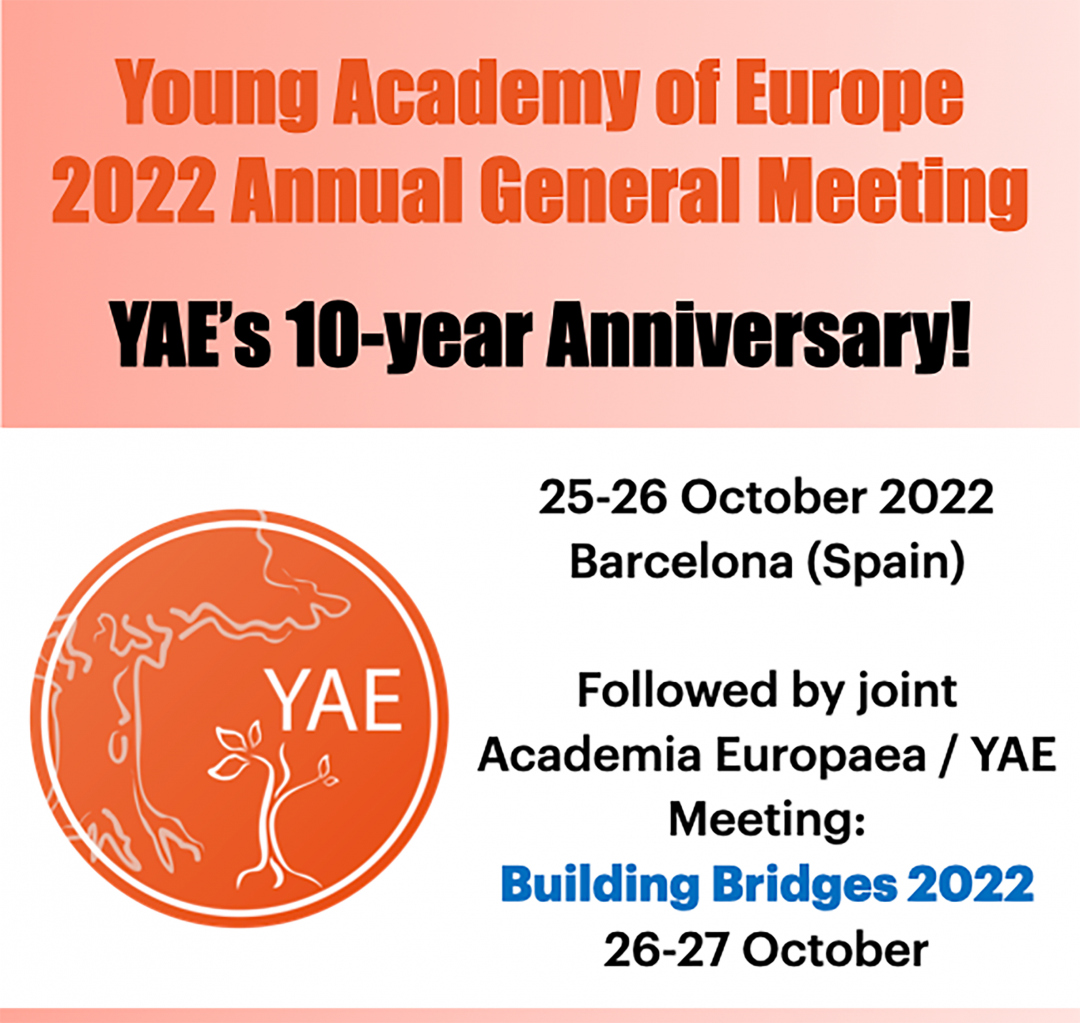
2022 Young Academy of Europe Annual Meeting

We are excited to announce that the 2022 YAE AGM will be an in-person meeting, held at the Universitat Pompeu Fabra Barcelona – Campus del Mar (Spain) in October. This year also marks the 10th anniversary of the YAE, and we are very much looking forward to celebrating this milestone together with you in Barcelona! 

The 2022 YAE annual meeting runs across Tuesday 25th October from 14:00 to 17:30 (room 226), and Wednesday 26th October from 09:30 to 12:00 (room 206). It will be held at the Universitat Pompeu Fabra, Mar Campus – see Building 61 in this map: https://www.upf.edu/en/web/campus/campus-mar. We will be in room 226 on Tuesday 25th and in room 206 on Wednesday 26th. We have put together an outstanding programme that includes renowned invited guests, research talks by recently admitted members, and opportunities for brainstorming and exchange. This includes a dedicated Science Communication Lab with expert guest speakers Profs. David Budtz-Pedersen and Rolf Hvidtfeldt. Please see the full programme below.

Registration to the full YAE AGM event is €130 – this includes access to all the AGM sessions on the 25th and 26th October, plus the YAE 10thanniversary dinner on Tuesday 25th. Please register using the link below (orange). This year you will register and pay for the AGM using the Eventbrite platform. After purchasing your ‘ticket’, Eventbrite will provide you with confirmation of your order. We understand that this order confirmation may not provide sufficient information for some of your institutions. If this is the case, please email Activity Chair Scott Bremer (Scott.bremer@uib.no) to request a more detailed invoice. When you contact Scott, provide your institution’s full name and address, and VAT number.

While registration is separate, the joint Academia Europaea / YAE meeting – Building Bridges 2022 – will go ahead immediately after our AGM in next door at the fabulous Parc de Recerca Biomedica de Barcelona. The programme includes excellent sessions including the Balzan lectures, the AE Gold Medal lecture, and two YAE-led sessions: a debate titled “Towards an inclusive and representative academic landscape” on Wednesday 26th, and the 2022 André Mischke YAE Prize lecture by this year’s awardee Dr. Gergely Toldi on Thursday 27st. We wholeheartedly encourage you to not miss these sessions! You can register for Building Bridges 2022 following the link below (blue).

Please note that the exact room where the YAE AGM will be convened is being finalised, and as soon as this information is available it will be updated on the website and emailed around to registered participants. This will include detailed instructions on how to get there. In planning your trip you may want to consult the Academia Europaea’s Building Bridges website for accommodation options: http://www.buildingbridges-acadeuro.org/accommodation/

Schedule

Young scientists’ roles in European science-for-policy

On the 14th of March, from 15.00-17.00 (CET) the Young Academy of Europe and Finnish Academy of Science and Letters are co-organising a seminar on the roles young scientists can play in European science advice. 

(European Commission, Directorate-General for Research and Innovation, How the Group of Chief Scientific Advisors works, Publications Office, 2021)

Young academies across Europe are attracting members who are increasingly interested in science-for-policy. But many young scientists are unsure about how science is marshalled for policy at the Europe level – for example via the European Science Advice Mechanism (SAM) and the Science Advice for Policy by European Academies (SAPEA) – and how they can become involved. With the Young Academies Science Advice Structure (YASAS) hopefully becoming an official partner of the new SAPEA+ project, now is an important moment for young scientists to explore the formal, and less formal, avenues for getting involved in science advice.

This seminar provides a space for Young Academy members across Europe to learn about and analyse the workings of the SAM, SAPEA and YASAS structures of science advice, and think about how they can contribute to science advice within these structures or otherwise.

The seminar goes beyond giving participants a ‘script’ for fitting within science advice structures. It enables participants to be part of questioning why these structures are as they are, unpack the complexity and non-linearity of science-for-policy in practice, and broaden their perspectives on scientific impact and how science supports societal decision-making.

The seminar will be divided into three parts: 

1. an introduction to SAM, SAPEA and YASAS; 
2. an interactive analysis of the SAM model by a panel of scientists and policy-makers who are actively working within this structure, including Jacek Kolanowski, Moniek Tromp, and Marie Jose van Tol, Pearl Dystra and Toby Wardman; and 
3. a discussion on the roles of scientists in science advice, with presentations from Tommi Himberg and Eeva Furman, who are engaging with science-for-policy in various ways.

The seminar will be hosted on Zoom, and all registered participants will receive a Zoom link on the day of the seminar. You can register here:

We look forward to seeing you there!

The YAE 10-year anniversary seminar series

In 2022 the YAE will turn 10 years old, and in celebration we are organising a seminar series to showcase the diversity of fascinating research within the Academy. Each month we organise a one-hour seminar with three short, accessible talks for an interdisciplinary audience; one each from Life Sciences, Physical Sciences and Engineering, and Social Sciences and Humanities. Seminars are on Zoom, open to YAE members and others, and will be filmed for wider dissemination.

There is one seminar left this year before the Annual General Meeting in October, and that will be on Tuesday the 27th of September, from 15.30 to 16.30. Please see the speakers and their topics below, and register via Eventbrite by clicking on the orange button. Registered attendees will be emailed a Zoom link the day before the event.

Moniek Tromp: Batteries: Towards Sustainable Energy Storage Systems

The urgency posed by global warming to transform our fossil fuel-dependent society into one based on renewable energy sources creates grand technological challenges, one of them being renewable energy storage for mobility and intermittent wind and solar electricity. Batteries are widely seen as key technology for electrification of transport, and for future medium-to-large scale electricity storage. This requires a huge leap in battery developments, especially regarding energy storage density, costs and materials (and process) sustainability, as well as recycling. 

Next generation battery chemistries that theoretically might fulfil these requirements are proposed, but to enable their implementation, parasitic reactions have to be diminished. These side reactions cause underperformance, degradation and finally battery failure. To improve battery performance, better insights in the reaction mechanisms occurring during discharge and charge cycles are required. Characterisation techniques and methods have been developed, with an emphasis on X-ray absorption spectroscopy (XAS), providing detailed electronic and structural information, in a time- and spatially resolved manner. Insights in for example deactivation pathways, mobility of speciation through the battery, have already led to novel material and cell designs.

Jan De Graaf: Europe’s Postwar Consensus: A Golden Age of Social Cohesion and Social Mobility?

In present-day Europe, the 1950s and 1960s are viewed with increasing nostalgia. In the public debate and in historiography, these decades are often described as a period when life was more simple and overall better – if not necessarily from a material perspective then certainly from a moral perspective. My research focuses on two themes that we have come to associate with this supposed “golden age” of European society: social cohesion and social mobility. We investigate not only the extent to which the “post-war consensus” was founded on mutual trust, common purpose, and increased life chances, but also which social groups benefited from it and how this is linked to the memory culture of the age. In doing so, we take a pan-European perspective, probing how the communist East and capitalist West tried to impose very different models of social cohesion and social mobility from above, but often saw their attempts at social engineering disintegrate in the face of societal resistance.

Eider Arenaza-UrquijoTopic to be confirmed

Film-viewing and discussion with film-maker James Muir

From 10-11am on Thursday the 16th of December, the Young Academy of Europe will host a film-viewing and discussion with New Zealand-based, award-winning documentary and film-maker James Muir. This event will appeal to scientists interested in the many roles film is coming to play in scientific research, as told from one film-maker’s perspective. 

Documentary-style film has long fulfilled a role in communicating scientific research to a broader public, but in recent years film has been added to scientists toolboxes of methods for conducting the research itself; from asking research subjects to film certain situations, to showing films to trigger workshop discussions. Indeed, with shifts toward conducting science in a ‘transdisciplinary’ mode, film-makers are becoming members of the research team, with a role in designing, conducting, analysing and communicating the research. This unlocks an exciting host of possibilities.

James Muir trained as a biologist specialising in behavioural ecology and conservation. He learnt filmmaking with Natural History New Zealand through his Masters Degree in Science Communication, and has since told stories that reveal the relationship between nature and human nature.

This event will be held on Zoom and is open to members of the Young Academy of Europe, but also non-members who find this interesting. On Monday 13 December, all registered attendees will be sent an email containing: (i) a Zoom link for the event; (ii) a link to Muir’s 30-minute long, documentary film ‘River Dog’, and (iii) a link to an accompanying scientific paper. Attendees should watch the film ahead of the Zoom event, because the event itself will consist of a live interview with Muir about River Dog and his perspectives on film in science, before opening up for a more general facilitated discussion on the topic among all attendees. 

This event is free. Please register your attendance before 5pm on the 15th of December, and note we cap the number of attendees at 100. You can register here.

We look forward to seeing you there.

ERC Starting Grant Mentoring Event Part 2 – Evaluation/Shortlisting

On 11th November 2021, between 14:00-16:00 CET, the Young Academy of Europe (YAE) in collaboration with the Academia Europaea (AE) Budapest Knowledge Hub will host an event for researchers who are interested in applying for the next round of European Research Council Starting Grants (ERC StG), with the ambition of widening participation to researchers from EU13 and Associated Countries.

In 2020, we organised a very well-attended virtual ERC StG mentoring event focused on providing guidance and support to applicants from countries under-represented among funded proposals. The event also included domain-specific break-out rooms with grant-writing advice by current YAE members who had successfully navigated through the process. The recordings and some more information from these sessions are available on our website and YouTube channel (Plenary Session and the domain-specific breakout sessions: Social Sciences and Humanities domain; Life Sciences domain and Physical Sciences and Engineering domain).

The second instalment of our mentoring events will be focused on how the ERC’s evaluation panels work and how decisions within evaluation panels are made to recommend a grant application for funding. This is an important opportunity for applicants to gain key insights into what makes a successful ERC application and a better understanding of the evaluation process.

The online event will include two parts. First, a plenary information session with a representative from the ERC Executive Agency (Janka Mátrai), and a talk by the ERC National Contact Point leader in Hungary (Gergely Bőhm) on typical comments of ERC evaluation reports. The main part of the event will include three parallel sessions, each with a mock ERC StG evaluation panel by domain: Physical Sciences & Engineering (PE), Life Sciences (LS), and Social Sciences & Humanities (SH).

Registration is free and can be done by clicking the button below:

Programme

Plenary session (14:00-15:00 CET)

  • 14:00-14:05 Opening (Gemma Modinos, YAE Chair; Éva Kondorosi, AE Budapest Hub Co-chair)
  • 14:05-14:30 Information session, The European Research Council: Funding opportunities and application and evaluation process (Janka Mátrai, ERCEA)
  • 14:30-14:45 Common mistakes and highly valued elements of ERC applications as seen by ERC evaluators (Gergely Bőhm, NCP Hungary)
  • 14:45-15:00 Q & A

Moderator: Katalin Solymosi (YAE, AE Budapest Hub)

Parallel break-out sessions (15:00-16:00 CET)

  1. Domain PE: Four panellists: László Forró, HAS; Eystein Jansen, AE; Katalin Kamarás, AE; Marcel Swart, AE. Moderator: Alina Mihaela Badescu (YAE).
  2. Domain LS: Four panellists: André Aleman, KNAW; Mara Dierssen, AE; Mandy McLean, AMS; Ole Petersen, AE. Moderator: Gemma Modinos (YAE).
  3. Domain SH: Four panellists: Marcel den Dikken, KNAW; Poul Holm, AE; Miklós Koren, AE; Peter Wagner, AE. Moderator: Pawel Korpal (YAE).

Young Academy of Europe 2021 Annual General Meeting

Register now for the 2021 YAE AGM! Due to the ongoing uncertainty regarding COVID-related travel restrictions, this will be a virtual meeting, held on Tuesday 19th October 2021, from 09:30 to 16:30. 

We will certainly miss seeing you all for in-person networking, but we know that the decision to go virtual is the right one, and the safe one. We are confident this high-quality virtual meeting will be an enriching, stimulating and enjoyable experience for all.

Registration to the event is free, by clicking the orange button below. We have put together an outstanding programme (below) that includes renowned invited guests, talks by our most recent members, and opportunities for brainstorming and collaboration.

Importantly, this year the joint Academia Europaea / YAE meeting – Building Bridges 2021 (BB2021) will also go ahead, immediately after our AGM. Among the AE’s excellent programme, we will be hosting two of the sessions on Thursday 21st: 

  • The 2021 André Mischke YAE Prize lecture by Prof. Marian Verhelst
  • A Panel Discussion on “Redefining Rewards & Recognitions for European Scholars” with four distinguished panelists

We wholeheartedly encourage you to join these sessions! You can register for BB2021 separately, following this link.

If you have any questions about the AGM or BB2021, please contact YAE Activities Chair Scott Bremer (email: scott.bremer@uib.no)

Sincerely,

The YAE Board

Full 2021 YAE AGM Programme:

09:30 – 10:00     
Welcome & update on activities 2020-21 (Gemma Modinos)
10:00 – 11:00   
Young Scholars for European Science Advice (Moniek Tromp)
11:00 – 11:30     Coffee break
11:30 – 12:00     
Welcome to the new 2021 YAE members (Gemma Modinos), Farewell to outgoing AE President (Sierd Cloetingh), and Welcome to new AE President (Marja Makarow)
12:00 – 13:00     
Research talks by new YAE members (moderator: Giulia Grancini)
13:00 – 14:30     Lunch break
14:30 – 15:15     
Updates by task forces (moderator: Scott Bremer)
15:15 – 16:00     
Brainstorming session – YAE in 2022 (moderator: Senem Aydın Düzgit)
16:00 – 16:15     Coffee break
16:15 – 16:25     
Election results (secretary: Katell Laveant; voting will take place online prior to AGM)
16:25 – 16:30    Close by newly elected YAE Chair
16:30.                End of 2021 YAE AGM